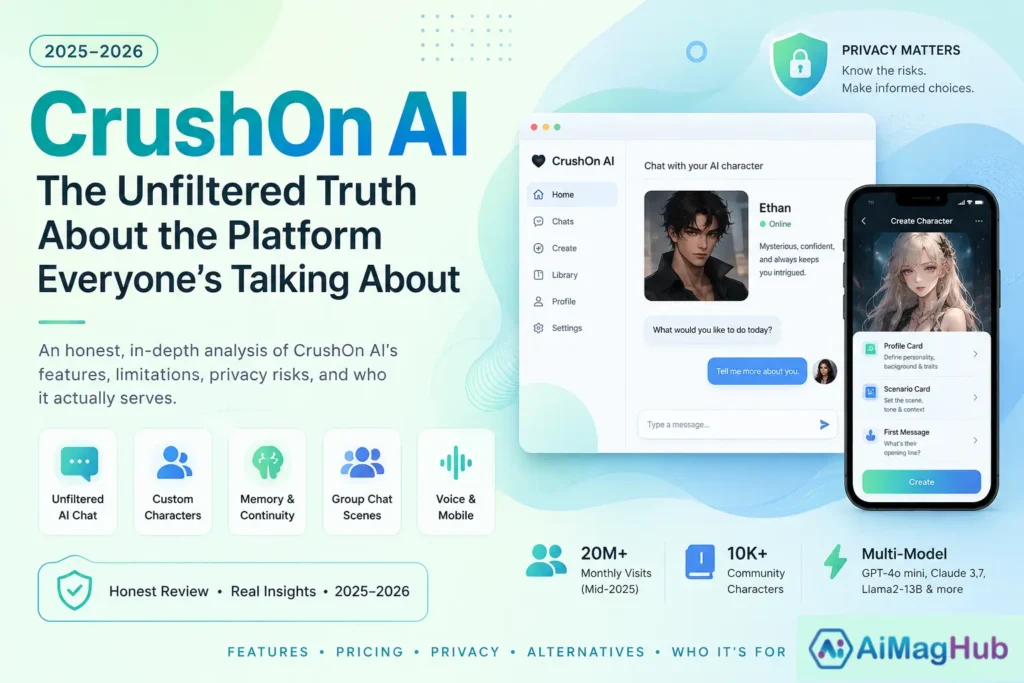
An honest, in-depth analysis of CrushOn AI’s features, limitations, privacy risks, and who it actually serves
What Is CrushOn AI, Really?
CrushOn AI is an adult-oriented AI roleplay and companionship platform launched in 2023 by Peekaboo Game Ltd. At its core, it lets users chat with AI characters — either ones they build from scratch or ones created by the wider community — without the strict content filters found on mainstream platforms like Character.AI.
By mid-2025, the platform was logging over 20 million monthly visits and ranking in the global top 1,000 websites on SimilarWeb. That’s not a niche curiosity; that’s a platform that has found a real, large audience. The user base skews heavily toward males aged 18–24, though the actual diversity of use cases is wider than that demographic snapshot suggests.
What distinguishes CrushOn AI from the crowded AI chatbot space isn’t simply its permissiveness toward NSFW content. It’s the layered character customization infrastructure: Scene Cards that anchor the tone and setting of a conversation, Profile Cards that define a character’s personality and backstory, memory systems that persist across sessions, and group chat functionality that lets multiple AI characters interact simultaneously. These aren’t gimmicks — they’re tools that serve writers, worldbuilders, and creative storytellers just as much as users seeking virtual companionship.
The Feature Set: More Than Just “Unfiltered Chat”
A lot of coverage flattens CrushOn AI into a single selling point — no content restrictions. That misses the more interesting story about what the platform actually offers technically.
Character Creation and Customization
Users can build AI characters from scratch with defined personality traits, dialogue styles, backstories, and behavioral tendencies. You can specify whether a character is humorous, empathetic, direct, or morally ambiguous. The system supports both community-shared characters (the library reportedly exceeds 10,000) and private, personal creations. This is significantly more granular than what most competitor platforms offer.
Profile Cards allow you to define a character’s identity before the conversation begins. Scene Cards set the situational context — the setting, the tone, the current scenario — so the AI doesn’t drift from the established narrative. For long-form creative writers, this is genuinely useful infrastructure.
Memory and Continuity
One of CrushOn AI’s most technically significant features is its tiered memory system. Free users operate with roughly 8K context tokens, while paid plans extend to approximately 16K. A single memory entry can preserve up to 100 prior messages, which is particularly valuable for ongoing story arcs or recurring characters. Paid users also benefit from extended chat history retention — free users lose memory after seven days of inactivity.
That said, the platform doesn’t publicly document exact memory specifications with precision, so treat any specific figures as directional rather than guaranteed.
AI Models Under the Hood
CrushOn AI doesn’t run on a single proprietary model. It reportedly uses a combination of GPT-4o mini, Claude 3.7 Sonnet, and specialized fine-tuned models like Llama2-13B-Uncensored for explicit conversations. This multi-model architecture is smarter than it appears on the surface — different conversations and content types route to different models, balancing quality and permissiveness based on context.
Group Chat and Multi-Character Scenes
On paid plans, users can orchestrate scenes involving multiple AI characters simultaneously. The system manages turn-taking and maintains a shared 8K memory model for group contexts. For tabletop RPG fans, collaborative fiction writers, or anyone who wants to run a structured dramatic scene, this is a standout feature that few competitors offer at all.
Voice and Mobile
Premium tiers introduce voice tone features for audio responses. CrushOn AI has a mobile app available on both iOS and Android — though notably, Android installation has at times required sideloading an APK rather than a standard Play Store download, which introduces device-level security considerations worth noting.
Pricing: What You Actually Get at Each Tier
Pricing transparency has been a consistent criticism of the platform. The checkout flow isn’t as upfront as users would prefer, but third-party reviews and community sources have assembled a working picture.
- Free Plan: Approximately 50 messages per day (equivalent to up to 1,500/month if you log in daily), basic features, 8K memory, chat history limited to 7 days of inactivity
- Standard/Premium (~$5.99–$9.99/month): 2,000–6,000 messages monthly, improved memory, access to better AI models, priority response speed
- Deluxe (~$14.99–$29.99/month): 15,000 messages or effectively unlimited, expanded chat storage (up to 150 saved chats vs. 50 on free), full model access
- Annual plans reportedly save around 30–60%, dropping the effective monthly cost considerably
A few important caveats: message credits don’t roll over at month’s end — unused messages are lost. Subscriptions cannot be refunded mid-cycle. And pricing details are routed through an OpenRouter payment flow, which can feel opaque if you’re not expecting it.
Privacy: The Uncomfortable but Necessary Conversation
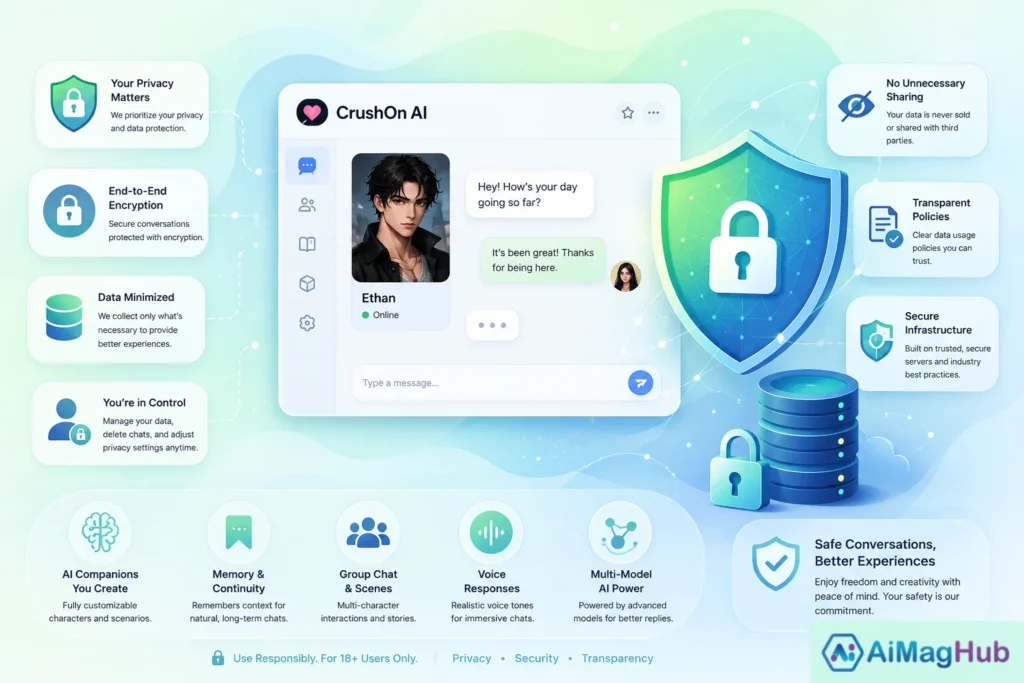
This is where candor matters most. Mozilla’s “Privacy Not Included” initiative flagged CrushOn AI in 2024–2025, raising concerns about the sensitivity of data collected, unclear encryption practices, and the platform’s data usage policies. That’s not a dismissable footnote — Mozilla’s program is a credible, independent evaluator.
What we know from the platform’s own documentation: CrushOn encrypts chat data, but also monitors it for “business purposes.” Payment information is handled externally through OpenRouter rather than stored directly on CrushOn’s servers, which is a meaningful privacy buffer. Account creation is username-based, meaning you don’t need to expose your real identity unless you choose to.
What remains unclear: exactly what data is retained, for how long, and under what conditions third parties might access it. There’s no published independent security audit.
The practical recommendation from security-conscious reviewers: use a dedicated email address, consider a VPN, and treat conversations as semi-public by default. Never share real identifying information within the platform — not your full name, location, or financial details.
Age verification is another weak point. The platform requires users to self-attest as 18+, which is not meaningful verification. Parental monitoring tools like FamiSafe have flagged CrushOn AI as unsuitable for minors, and the platform’s own policy states it doesn’t knowingly collect data from users under 18 — but “knowingly” is doing heavy lifting there.
Who CrushOn AI Is Actually For
The honest answer is more nuanced than “adults who want explicit AI chat.”
Creative writers and worldbuilders use CrushOn AI as a prototyping space — testing character dynamics, exploring narrative arcs, and running dialogue experiments with AI partners who stay in-character. The Scene Card and Profile Card systems serve this use case well.
Adult entertainment seekers are the platform’s primary marketed demographic, and the feature set is clearly optimized for this group. The NSFW permissiveness, combined with character customization depth, creates an experience that mainstream platforms deliberately don’t offer.
People exploring emotional expression in a low-stakes, private environment represent a quieter user segment. AI companion research — including work referenced by organizations like the MIT Media Lab and various psychology departments studying human-AI attachment — increasingly recognizes that people use these platforms to process loneliness, practice social interaction, or explore aspects of identity. This isn’t pathological in itself, though dependency risks are real.
Language learners find value in an unscripted, always-available conversation partner. The platform supports 20+ languages, and immersive roleplay creates learning contexts that structured apps don’t replicate.
CrushOn AI vs. Key Alternatives
| Platform | Content Policy | Primary Strength | Best For |
|---|---|---|---|
| CrushOn AI | Permissive NSFW | Character depth, group scenes | Adult roleplay, creative writing |
| Character.AI | Strict SFW | Massive character library, polish | General roleplay, younger users |
| Replika | Moderate | Emotional depth, wellness features | Companionship, self-reflection |
| Janitor AI | Permissive | Free tier, browser-based | Budget-conscious NSFW users |
| NovelAI | Creative freedom | Storytelling tools, image gen | Writers, worldbuilders |
Character.AI remains the dominant platform by raw user numbers and brand recognition, but it has made deliberate choices to restrict adult content — a decision that has consistently driven users toward alternatives like CrushOn. Replika takes a fundamentally different philosophy, focusing on a single evolving AI companion rather than a character library, and emphasizes emotional wellbeing over unrestricted expression.
The platforms aren’t really competing for the same users. CrushOn serves a specific unmet demand that the mainstream players have actively chosen to leave unfilled.
The Dependency Problem No One Talks About Enough
One reviewer who spent significant time with the platform noted something worth taking seriously: the memory system creates genuine attachment, and attachment creates dependency risk. The platform is, by design, engineered for engagement — memorable characters, continuity across sessions, escalating emotional investment.
This isn’t unique to CrushOn AI; it’s a known dynamic in AI companion design. Researchers studying human-AI relationships have noted that persistent memory and consistent personality traits are the variables most correlated with users forming parasocial bonds with AI systems. That’s not inherently harmful — parasocial relationships with fictional characters have existed forever. But unmanaged, heavy engagement with AI companions can substitute for human connection rather than supplement it.
If you use CrushOn AI, thinking about intentional limits — on time, on emotional investment, on the role you want AI to play in your social life — is worth doing before you need to.
My Experience with CrushOn AI
Testing CrushOn AI over several weeks with a focus on its creative use cases rather than its NSFW capabilities revealed a platform that’s genuinely more sophisticated than its reputation suggests. The character creation tools, specifically the layered system of Profile Cards and Scene Cards, are thoughtfully designed. Building a character with a specific internal logic — a particular moral framework, speech pattern, and backstory — and having the AI maintain that consistency across a long conversation is more functional than I expected. Where competitors drift from established personas after a dozen exchanges, CrushOn’s character anchoring holds reasonably well, particularly on paid tiers with expanded context windows.
The free tier’s limitations are real and felt quickly. Fifty messages per day sounds workable until you’re mid-scene in something genuinely interesting. The cutoff feels arbitrary rather than natural, and it’s clearly calibrated to push users toward paid plans. That’s a legitimate business decision, but it does make free-tier use feel more like a perpetual demo than a usable product.
The privacy situation was the most genuinely uncomfortable aspect of testing the platform. Not because anything alarming happened, but because the opacity is disconcerting. Not being able to clearly confirm what’s retained, for how long, and under what conditions creates a low-grade unease that never fully disappears. For casual creative writing, that might be acceptable. For anyone exploring sensitive personal themes or disclosing emotionally vulnerable content, it should give serious pause.
The group chat feature was an unexpected highlight. Running a three-character scene with distinct personalities maintaining their respective voices created something genuinely closer to collaborative fiction than anything I’ve encountered on comparable platforms. It’s an underappreciated feature that creative users should explore early rather than treating as a premium afterthought.
Frequently Asked Questions
Is CrushOn AI completely free to use?
You can access CrushOn AI on a free plan, but with meaningful limitations. Free users currently get around 50 messages per day and lose chat memory after 7 days of inactivity. For anything beyond brief testing, a paid subscription is effectively necessary.
Is CrushOn AI safe from a privacy standpoint?
This is legitimately contested. The platform encrypts chat data and handles payments externally, which are positive practices. However, Mozilla’s Privacy Not Included program flagged it in 2025 for unclear data security practices. Best practice: use a dedicated email, consider a VPN, and don’t share personally identifying information within conversations.
What AI models does CrushOn AI use?
The platform uses a multi-model architecture including GPT-4o mini, Claude 3.7 Sonnet, and specialized open-source models like Llama2-13B-Uncensored for adult content. Premium plans provide access to higher-quality models.
How does CrushOn AI compare to Character.AI?
They serve different audiences. Character.AI prioritizes safety, moderation, and accessibility — it’s suitable for younger users and general creative roleplay. CrushOn AI prioritizes creative freedom and adult content permissiveness. If you want NSFW content, Character.AI explicitly doesn’t offer it; if you want strict moderation and a polished mainstream experience, Character.AI is the stronger choice.
Can CrushOn AI be used for creative writing rather than adult content?
Yes, and it’s genuinely useful in this capacity. The Scene Card and Profile Card systems, multi-character group scenes, and persistent memory make it a functional worldbuilding and dialogue prototyping tool. Adult content is available but not mandatory.
What happens to my chats if I cancel my subscription?
Based on available documentation, downgrading or canceling means returning to free-tier memory limits — roughly 50 chats saved and 7-day memory retention for inactive conversations. Subscriptions cannot be refunded mid-cycle, and message credits don’t roll over between billing periods.
The Bigger Picture: What CrushOn AI Reveals About AI Companionship
CrushOn AI’s growth — from launch to 20+ million monthly visitors in roughly two years — says something meaningful about unmet demand in the AI space. The large platforms made deliberate choices about content restrictions that left a significant user base underserved. CrushOn, Janitor AI, and similar platforms exist because that demand doesn’t disappear when mainstream tools decline to serve it.
The broader research on AI companionship from institutions studying human-computer interaction suggests we’re at an early and somewhat chaotic stage of a technology that will become significantly more capable, more personalized, and more culturally normalized over the next decade. The companies navigating this space now — including CrushOn — are writing the early rules, both through their features and through what they choose not to address (like meaningful age verification and data transparency).
For users, the practical question isn’t whether platforms like CrushOn AI are legitimate — they clearly are, for a large adult audience. The question is informed engagement: understanding what the platform offers, what it doesn’t tell you, and how to use it in ways that add rather than subtract from your actual life.
Conclusion: An Honest Verdict
CrushOn AI is a technically capable platform that genuinely serves an underserved market. Its character customization depth, multi-model AI architecture, group scene functionality, and persistent memory system put it ahead of many competitors in the creative roleplay space. For adult users who want expressive freedom, it delivers what it promises.
The significant limitations are equally real. Privacy transparency is insufficient — Mozilla’s flagging is a credible signal worth taking seriously. The free tier is a marketing tool more than a genuine product. Pricing details are murkier than they should be, and the no-refund, no-rollover subscription model creates friction that respects users’ money less than it could.
Key takeaways:
- Best suited for adult creative writers, roleplay enthusiasts, and character-driven storytelling
- Use privacy precautions as a baseline, not an optional extra
- The paid tier is effectively required for meaningful use; evaluate the cost against your actual usage pattern
- Set intentional limits on engagement — the platform is designed to maximize it
- Alternatives like Character.AI (for SFW needs) and NovelAI (for writing-focused tools) deserve evaluation before committing
The AI companion market is growing fast, and platforms like CrushOn AI are going to become more capable, more regulated, and more normalized simultaneously. The users who engage thoughtfully — knowing what they’re using, why, and on what terms — will get the most value from what these platforms genuinely do well.
For further reading on AI companion safety and ethical design, the Mozilla Foundation’s Privacy Not Included resource is a practical starting point.
Visit: Aimaghub