
Introduction
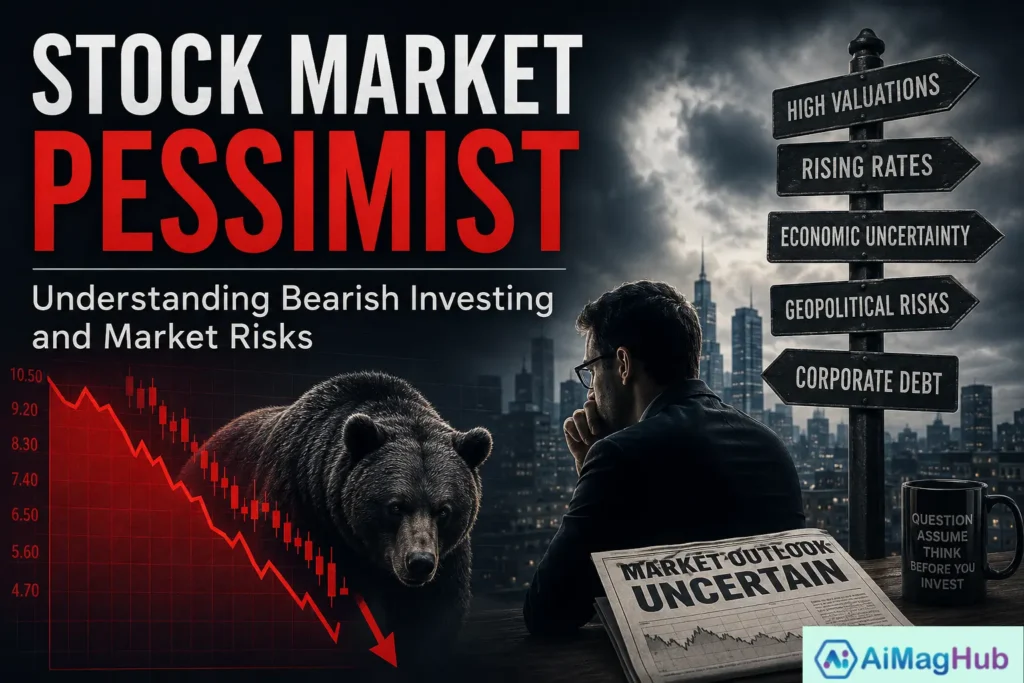
A stock market pessimist is someone who believes financial markets are overvalued, economic risks are underestimated, or future stock returns may be weaker than investors expect. While pessimists are often associated with market crashes and doom-and-gloom predictions, their role in the investment ecosystem is far more important than many people realize.
Markets function best when both optimistic and skeptical viewpoints coexist. Optimists drive innovation and capital formation, while pessimists challenge assumptions, expose risks, and help prevent speculative bubbles from growing unchecked.
In today’s environment—characterized by artificial intelligence, rising government debt, geopolitical tensions, and rapid technological change—the debate between bulls and bears remains as relevant as ever. Understanding the mindset of a stock market pessimist can help investors make more balanced decisions and avoid costly mistakes.
What Is a Stock Market Pessimist?
A stock market pessimist is an investor, analyst, economist, or market observer who believes that stock prices are likely to decline or that market risks are being underestimated.
Unlike casual negativity, informed pessimism is usually based on factors such as:
- Excessive market valuations
- Economic slowdown concerns
- Corporate earnings weakness
- Rising interest rates
- Debt accumulation
- Geopolitical instability
- Market speculation and bubbles
A pessimist is not necessarily always bearish. Many respected investors become pessimistic only when evidence suggests risks outweigh potential rewards.
Quick Definition
Stock Market Pessimist: An individual who expects weaker stock market performance due to economic, financial, or valuation-related concerns.
Why Stock Market Pessimists Matter
Many investors dismiss pessimists because financial markets tend to rise over long periods. However, history shows that skepticism often serves an important purpose.
Pessimists help investors:
- Identify hidden risks
- Challenge consensus thinking
- Avoid emotional investing
- Evaluate valuations more carefully
- Prepare for economic downturns
Without skeptical voices, markets can become dangerously euphoric.
The housing bubble preceding the 2008 financial crisis is a classic example. A small group of analysts and investors questioned the prevailing optimism and identified structural weaknesses long before the broader market recognized them.
The Difference Between a Pessimist and a Bear
These terms are often used interchangeably, but they are not identical.
| Pessimist | Bear |
|---|---|
| Focuses on risks and potential negatives | Expects prices to decline |
| May remain invested | Often takes bearish positions |
| Can be cautious long-term | Often makes short-term market calls |
| Emphasizes risk management | Emphasizes downside opportunities |
A person can be pessimistic without actively betting against the market.
Common Reasons Investors Become Pessimistic
High Market Valuations
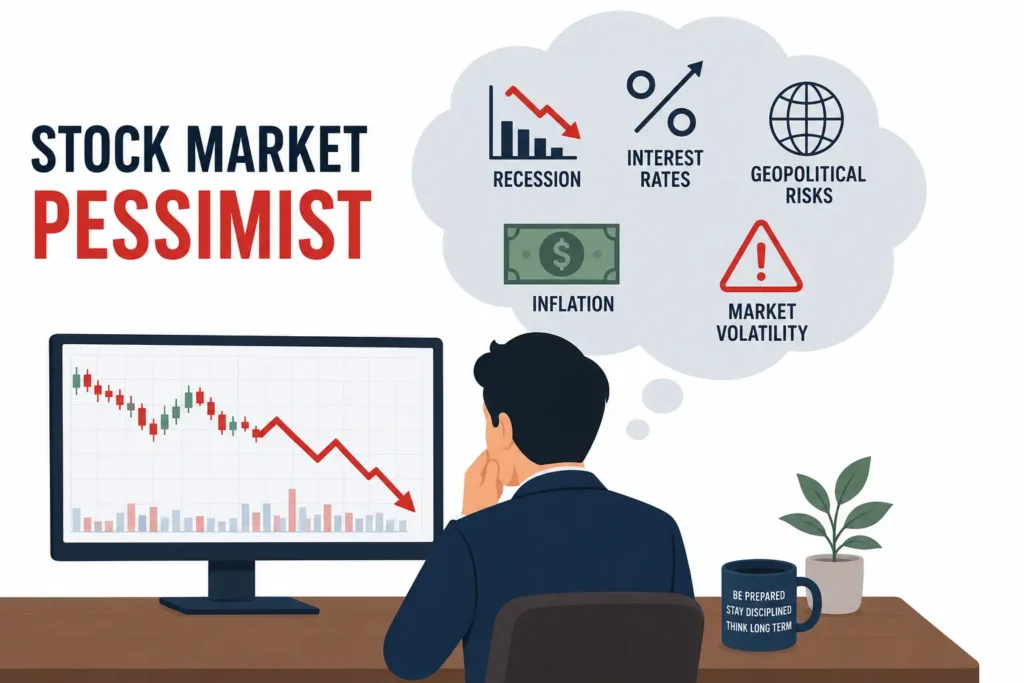
When stocks trade at historically elevated price-to-earnings ratios, pessimists worry future returns may be limited.
Many market skeptics closely monitor metrics popularized by renowned investors and economists, including:
- P/E ratios
- Shiller CAPE ratio
- Market capitalization to GDP
- Corporate profit margins
High valuations do not guarantee a crash, but they can reduce future return expectations.
Economic Uncertainty
Economic slowdowns often trigger pessimistic outlooks.
Factors include:
- Rising unemployment
- Declining consumer spending
- Manufacturing weakness
- Recession risks
Institutions such as the International Monetary Fund and World Bank regularly publish forecasts that investors use to evaluate economic risks.
Interest Rate Increases
Higher rates can:
- Increase borrowing costs
- Reduce corporate profitability
- Lower consumer spending
- Pressure stock valuations
This is why pessimism often rises during tightening cycles by central banks.
Excessive Investor Euphoria
Paradoxically, some pessimists become most concerned when everyone else is optimistic.
Common warning signs include:
- Meme stock mania
- Speculative IPO activity
- Excessive leverage
- Unrealistic growth assumptions
- Fear of missing out (FOMO)
Historically, extreme optimism has often preceded major market corrections.
Famous Stock Market Pessimists
Several well-known investors and economists have gained reputations for market skepticism.
Jeremy Grantham
Known for identifying asset bubbles and warning about overvalued markets.
Nouriel Roubini
Earned recognition for warning about vulnerabilities before the 2008 financial crisis.
John Hussman
Frequently analyzes valuation risks and long-term market return expectations.
Michael Burry
Became widely known after correctly identifying weaknesses in the U.S. housing market before the financial crisis.
Not all their predictions have been correct, but their research demonstrates how pessimistic analysis can uncover overlooked risks.
The Biggest Misconception About Market Pessimists
One of the most common misconceptions is that pessimists are always wrong because markets generally rise over time.
The reality is more nuanced.
Many pessimists correctly identify:
- Overvaluation
- Excessive risk-taking
- Unsustainable debt levels
- Market bubbles
Their challenge often lies in timing.
Markets can remain overvalued for years before a correction occurs. Being early can appear identical to being wrong.
This distinction is critical for investors evaluating bearish forecasts.
When Pessimism Becomes Dangerous
Not all pessimism is constructive.
Excessive pessimism can cause investors to:
- Miss long-term opportunities
- Stay in cash too long
- Ignore innovation trends
- Underestimate economic resilience
For example, investors who permanently exited equities after the 2008 financial crisis missed one of the strongest bull markets in history.
The goal should not be permanent pessimism but balanced skepticism.
My Experience with Stock Market Pessimist
Over the years, I have followed both bullish and bearish market commentators while researching investment strategies and market cycles. One observation that consistently stands out is that pessimists often ask better questions than optimists.
When markets are rising rapidly, optimistic narratives tend to dominate headlines. During these periods, I found that reading bearish analyses helped identify risks that were largely ignored by the broader market. Even when the bearish predictions did not immediately materialize, they often highlighted legitimate concerns about valuations, debt, or investor behavior.
Another lesson I learned is that timing matters tremendously. Several respected pessimists correctly identified risks years before markets eventually corrected. Investors who followed those warnings blindly sometimes missed significant gains before the downturn arrived. This taught me that being fundamentally correct does not always translate into successful investment outcomes.
I also noticed that the most valuable pessimists are not those predicting collapse every year. Instead, they focus on probabilities, risk management, and evidence-based analysis. Their insights can improve portfolio decisions even when markets continue moving higher.
Perhaps the most important takeaway is that investors should neither ignore pessimists nor follow them uncritically. The best results often come from combining skeptical analysis with a long-term investment perspective.
How Smart Investors Use Pessimistic Research
Experienced investors often use pessimistic viewpoints as a decision-making tool rather than a prediction tool.
They may ask:
- What risks am I overlooking?
- What assumptions does my portfolio depend on?
- How would my investments perform during a recession?
- Am I overexposed to one sector?
- Are valuations justified?
This approach improves risk awareness without requiring investors to abandon growth opportunities.
The Future of Market Pessimism
Several emerging trends may strengthen pessimistic arguments in coming years:
Government Debt Expansion
Many developed economies continue accumulating significant debt burdens.
AI-Driven Market Concentration
The rapid growth of artificial intelligence has increased concentration among a relatively small number of technology companies.
Geopolitical Fragmentation
Trade disputes, regional conflicts, and supply chain shifts may create additional uncertainty.
Demographic Changes
Aging populations in many countries could affect economic growth and investment returns.
At the same time, technological innovation, productivity improvements, and new industries could offset many of these concerns.
The future is unlikely to be entirely bullish or bearish—it will probably contain elements of both.
Frequently Asked Questions
Is a stock market pessimist always bearish?
No. A stock market pessimist focuses on risks and potential weaknesses but may still own stocks and maintain a long-term investment strategy.
Are stock market pessimists usually correct?
Sometimes. Pessimists often identify genuine risks, but predicting the timing of market declines is extremely difficult.
Can pessimism help investors?
Yes. Constructive pessimism can improve risk management, portfolio diversification, and decision-making.
What causes investors to become pessimistic?
Common factors include high valuations, recession fears, rising interest rates, debt concerns, and speculative market behavior.
Who are some famous market pessimists?
Notable examples include Jeremy Grantham, Nouriel Roubini, John Hussman, and Michael Burry.
Should investors follow pessimistic forecasts?
Investors should consider pessimistic viewpoints as one input among many rather than treating them as certainty.
Is pessimism good during bull markets?
Balanced skepticism can be valuable during bull markets because it helps investors avoid excessive risk-taking and emotional decisions.
Conclusion
A stock market pessimist is not simply someone who expects prices to fall. At their best, pessimists serve as critical thinkers who challenge assumptions, identify overlooked risks, and encourage disciplined investing.
History shows that some of the most important warnings in financial markets came from individuals willing to question prevailing optimism. However, excessive pessimism can be just as harmful as excessive optimism.
The most successful investors often combine both perspectives. They remain optimistic about long-term economic growth while staying realistic about short-term risks and market cycles.
The key takeaway is simple: don’t fear pessimistic analysis—use it wisely. By understanding what market skeptics see, investors can make more informed decisions, manage risk more effectively, and build portfolios that are better prepared for an uncertain future.
For additional educational resources on investing and market behavior, readers may find insights from Investopedia and CFA Institute Research Foundation helpful.
For more insightful articles, expert guides, and the latest updates, visit AIMagHub