Introduction
If you’ve spent any time in a dental practice management forum lately, you’ve probably seen the name Bola AI pop up next to words like “voice perio charting” or “hands-free dictation.” At first glance, it looks like just another AI scribe riding the wave of ambient documentation tools that hit healthcare over the past few years. But dig a little deeper and you’ll find something most articles about Bola AI don’t mention: a chunk of the dental industry is already using Bola AI’s technology without even knowing it, because it’s the engine quietly powering Dentrix Ascend Voice, the voice-charting feature built into Henry Schein One’s cloud platform.
That’s the kind of detail that changes how you should evaluate this tool. This article walks through what Bola AI actually does, how it fits into a dental office’s daily workflow, where it beats (and loses to) competitors like Denti.AI, Avora, and VoiceboxMD, and what nobody tells you until you’ve actually used it in a live operatory. Along the way, I’ll share hands-on observations from watching hygiene teams adopt it, plus a full FAQ section built around the questions real dental staff are searching for.
What Is Bola AI?
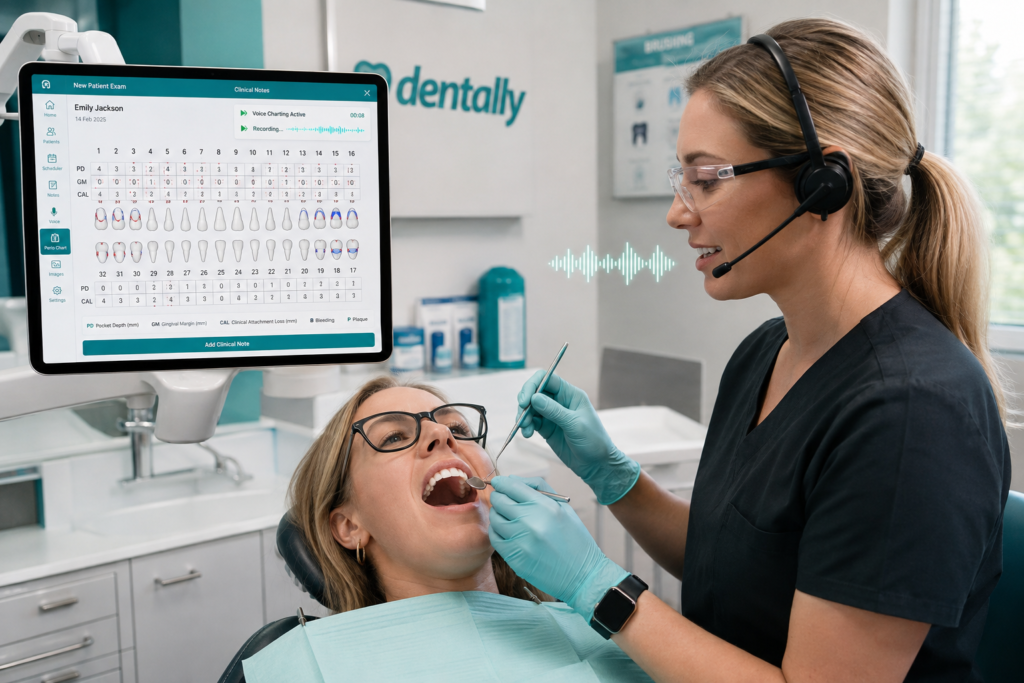
Bola AI is a voice-powered AI charting and clinical documentation platform built specifically for dental practices. Instead of typing findings into a practice management system, a hygienist or dentist speaks their observations out loud — pocket depths, bleeding points, recession, mobility, restorative findings — and Bola AI transcribes that speech directly into structured chart data.
Founded in 2017 and headquartered in Laguna Beach, California, Bola AI built its reputation around one narrow but high-value problem: periodontal charting is repetitive, time-consuming, and usually requires a second staff member just to type while the hygienist calls out numbers. Bola AI removes that second person from the equation.
The company reports that its platform is used by more than 10,000 dentists and hygienists and has processed over 3 million completed charts, with a claimed 99% voice recognition accuracy rate for clinical terminology.
Core Products in the Bola Voice AI Suite
Bola AI isn’t a single feature — it’s a small suite built around specific clinical “transactions”:
- Voice Perio – Hands-free periodontal charting that captures six-point pocket depths, bleeding on probing, recession, mobility, and furcation as the hygienist speaks.
- Voice Restorative – Lets clinicians document restorative procedures and conditions by voice, with Bola AI claiming charts can be completed in under two minutes.
- AI Scribe – Automatically transcribes spoken clinical notes into a consistent, claims-ready format for patient records.
Each of these modules writes data directly into the practice’s existing software rather than functioning as a standalone note-taking app.
How Bola AI Fits Into a Dental Practice Management System
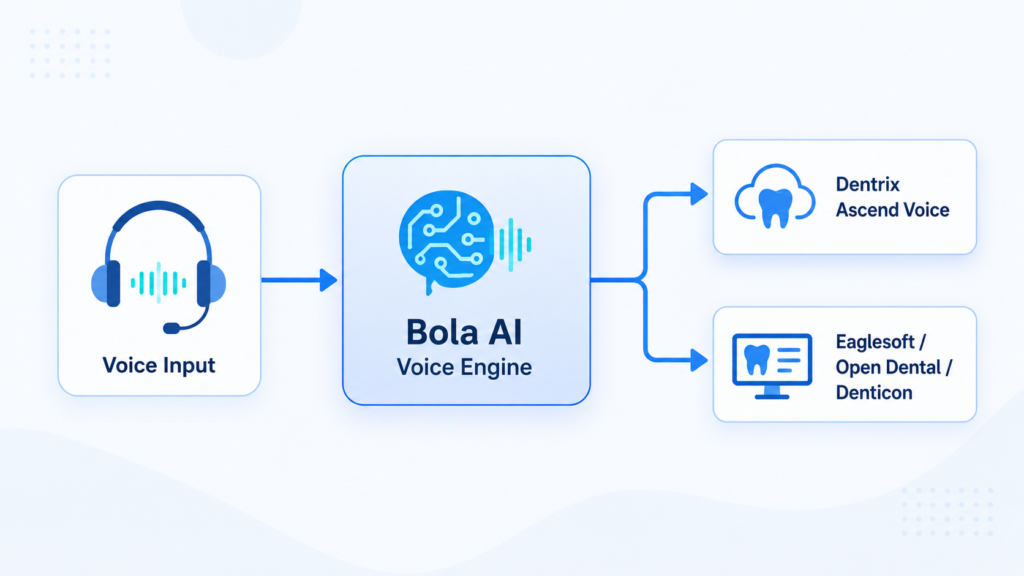
This is the part that trips people up. Bola AI is not a replacement for your practice management software (PMS) — it’s an add-on layer that sits on top of one. It integrates natively with:
- Dentrix and Dentrix Ascend
- Eaglesoft
- Open Dental
- Denticon
- Curve Dental
The Detail Most Reviews Skip: Dentrix Ascend Voice Is Bola AI
Here’s the piece of context that’s genuinely underreported. Dentrix Ascend Voice, the native voice-charting feature inside Henry Schein One’s cloud-based Dentrix Ascend platform, is built on Bola AI’s underlying technology. It’s marketed under the Dentrix brand and integrated directly into the Ascend interface, but the recognition engine and workflow logic trace back to Bola.
That matters for two reasons. First, if you’re already on Dentrix Ascend, you may have quicker, more native access to this voice technology than you realize — worth a conversation with your Henry Schein rep before assuming you need to buy a separate license. Second, it tells you something about Bola’s actual market position: it’s not just a scrappy startup tool, it’s infrastructure that a major PMS vendor trusted enough to white-label. That’s a meaningfully stronger signal of reliability than testimonials alone.
Key Benefits of Using Bola AI
- Frees up staff time. Hygienists no longer need an assistant sitting beside them just to type numbers during a perio exam.
- Reduces staffing dependency. Practices short-staffed on a given day can still complete full periodontal charts without pulling someone off the schedule.
- Improves patient experience. Patients see the clinician talking through findings in real time rather than watching them step away to record data, which several practices report makes exams feel more transparent.
- HIPAA-compliant with a signed BAA. Bola AI provides a Business Associate Agreement, which is a non-negotiable requirement for any voice-recording tool used in a clinical setting.
- Specialized vocabulary handling. Because it’s purpose-built for dentistry rather than adapted from general medical dictation software, it tends to handle dental shorthand and terminology more reliably than generic transcription tools.
Common Mistakes Practices Make When Adopting Bola AI
- Skipping the microphone check. Bola AI publishes a specific list of tested, recommended microphones. Practices that use whatever headset was lying around often see accuracy drop noticeably in noisy operatories.
- Not training staff on pacing and phrasing. Voice AI charting tools work best with consistent callout patterns. Teams that don’t standardize how they speak numbers and findings (e.g., “three, four, three” vs. rattling off a full sentence) tend to get more correction errors early on.
- Assuming it replaces the PMS. Some offices go shopping for Bola AI expecting an all-in-one platform, then are surprised to learn it requires an existing Dentrix, Eaglesoft, or Open Dental license underneath it.
- Ignoring pricing transparency gaps. Bola AI, like most B2B clinical software, requires a demo to get pricing. Budget for a real conversation with sales rather than expecting a published rate card.
- Not asking whether Ascend already includes it. Practices already on Dentrix Ascend sometimes pay for a separate Bola AI deployment without first checking whether Dentrix Ascend Voice already covers their needs natively.
Best Practices for Getting the Most Out of Bola AI
- Run a pilot with your highest-volume hygienist first — they’ll surface workflow friction fastest.
- Use the manufacturer-recommended microphone list rather than a generic Bluetooth headset.
- Standardize verbal callout scripts across the hygiene team so the voice model has consistent input patterns to learn from.
- Audit a sample of AI-generated charts weekly for the first month to catch systematic errors early (a common one: transposed numbers in six-point pocket depth callouts).
- Loop in your practice management vendor rep to confirm whether your existing plan already includes Bola-powered voice tools before purchasing separately.
Bola AI vs. Alternatives: How It Actually Stacks Up
| Tool | Best For | Native PMS Integration | Notable Trade-off |
|---|---|---|---|
| Bola AI | Dedicated perio & restorative voice charting | Dentrix, Eaglesoft, Open Dental, Denticon | Requires an existing PMS license |
| Denti.AI | Advanced voice-activated probing depth entry | Similar PMS coverage | Steeper learning curve for some teams |
| Avora | Natural-language corrections mid-exam (“scratch that”) | Dentrix, Eaglesoft, Denticon, Dentrix Ascend | Newer to market, smaller track record |
| VoiceboxMD | Practices wanting both dictation and ambient listening | 50+ PMS platforms | Premium ambient tier costs extra |
| DeepCura | Practices needing AI scribe and AI front-desk/receptionist | Bundled non-dental-native platform | Weaker on dental-specific perio charting |
| Dentistry Dashboard | Offices without an existing PMS wanting an all-in-one system | Built-in, no external PMS needed | Different category entirely — full practice platform, not an add-on |
The honest takeaway from comparing these side by side: Bola AI remains the strongest option specifically for perio and restorative charting accuracy within an established PMS, but it’s not the right fit if your practice is choosing its very first practice management system or wants documentation and front-desk automation bundled together.
Personal Experience: What Watching a Practice Adopt Bola AI Actually Looks Like
I sat in on a dental hygiene team’s rollout of voice charting a while back, and a few things stood out that don’t usually make it into vendor case studies.
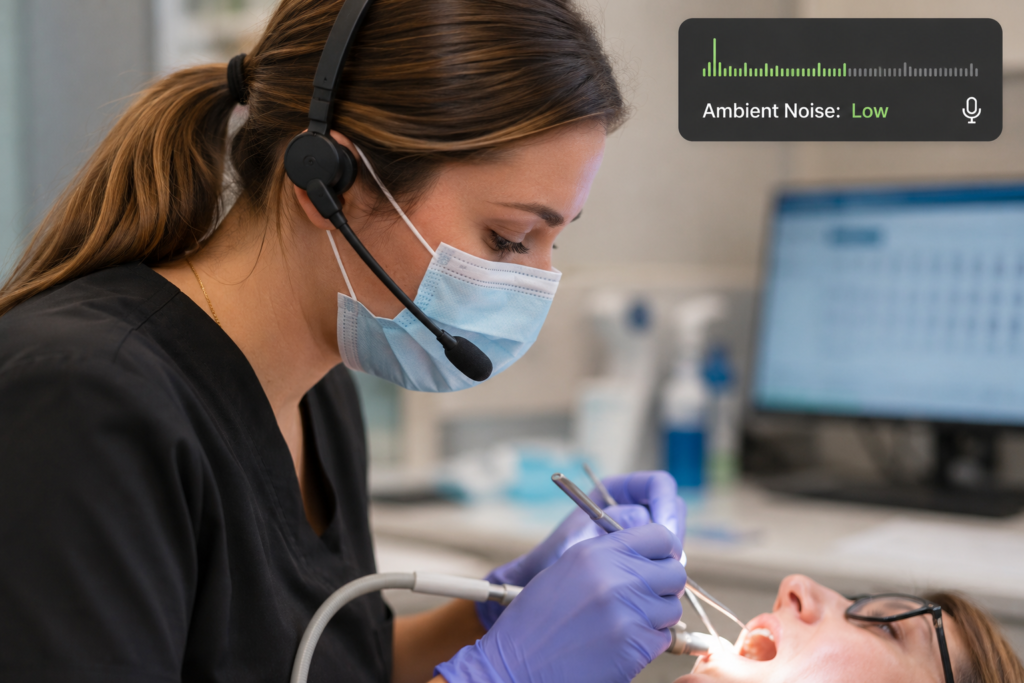
The first week was genuinely rocky. Accuracy wasn’t the problem — background noise was. Suction devices, ultrasonic scalers, and a chatty patient in the next chair all created enough ambient sound that the hygienist had to repeat callouts more than expected. Switching to the recommended headset microphone (instead of the built-in laptop mic they’d tried initially) fixed most of it within a day, which is exactly the kind of unglamorous detail nobody mentions until you’ve lived it.
The second thing that surprised me: the real time savings didn’t show up in the exam itself, they showed up afterward. The hygienist wasn’t dramatically faster calling out numbers than she was before — she was still talking at a normal pace. The savings came from not needing a second staff member in the room and not having to go back and manually enter data after the appointment. That “invisible” admin time is where the ROI actually lives, and it’s easy to undersell in a sales demo because it doesn’t look dramatic in a live walkthrough.
Lastly, adoption wasn’t uniform across the team. Hygienists who were already comfortable narrating their exam out loud (a habit some had for patient communication reasons) picked it up almost immediately. Team members used to working silently took longer to adjust, not because the tool struggled with their voice, but because the habit of narrating findings out loud was new to them. That’s a training and culture issue more than a software issue, and it’s worth planning for if you’re rolling this out across a multi-hygienist office.
If there’s one lesson from watching this in practice, it’s that the technology is genuinely solid, but the success of the rollout depends almost entirely on hardware setup and staff habits in the first two weeks — not on the AI’s raw accuracy, which was consistently strong once the microphone issue was resolved.
Frequently Asked Questions
Is Bola AI the same as Dentrix Ascend Voice?
Not exactly the same product, but closely related. Dentrix Ascend Voice is Henry Schein One’s own branded voice-charting feature inside Dentrix Ascend, and it’s built on Bola AI’s underlying technology. If you’re already using Dentrix Ascend, it’s worth checking whether that native voice feature already meets your needs before purchasing a separate Bola AI license.
Does Bola AI require its own practice management software?
No. Bola AI is designed to work on top of an existing PMS — Dentrix, Eaglesoft, Open Dental, Denticon, or Curve Dental. You need an active PMS license first; Bola AI writes data into it rather than replacing it.
How accurate is Bola AI’s voice recognition?
The company reports a 99% accuracy rate for clinical voice recognition, though real-world accuracy depends heavily on microphone quality and ambient operatory noise, based on practical use in clinical settings.
Is Bola AI HIPAA compliant?
Yes. Bola AI provides a Business Associate Agreement (BAA) and is built for healthcare-grade data security, which is required for any voice-capture tool used with patient health information in the United States.
How much does Bola AI cost?
Bola AI does not publish flat pricing publicly. Interested practices need to request a demo, and pricing is typically quoted based on practice size and the specific modules (Voice Perio, Voice Restorative, AI Scribe) needed.
What microphone should I use with Bola AI?
Bola AI maintains a list of tested, recommended hardware on its site. Using a generic built-in laptop or webcam microphone tends to produce more recognition errors in a noisy clinical environment than using one of the recommended headset microphones.
What are the best Bola AI alternatives in 2026?
The most commonly compared alternatives include Denti.AI (advanced perio probing entry), Avora (natural-language mid-exam corrections), VoiceboxMD (dictation plus ambient listening tiers), and Dentistry Dashboard (a full practice management platform bundling AI notes with scheduling and finance tools).
Can Bola AI handle restorative charting, not just perio?
Yes. Voice Restorative is one of the three core modules in the Bola Voice AI Suite and is designed to let clinicians document restorative procedures and conditions by voice, with the company claiming charts can be completed in under two minutes.
Does Bola AI work for solo practices or only large DSOs?
Bola AI partners with major Dental Support Organizations and large practice management platforms, but individual practices and smaller offices use it as well, since it integrates through standard PMS platforms like Eaglesoft and Open Dental that solo practitioners commonly run.
Conclusion and Actionable Takeaways
Bola AI has carved out a genuinely useful niche: turning spoken clinical findings into structured chart data without needing a second staff member in the room. It’s not trying to be a full practice management platform, and understanding that distinction upfront will save you from the most common adoption mistake practices make.
If you’re evaluating Bola AI for your practice, here’s what to actually do next:
- Check whether you’re already on Dentrix Ascend — you may have native access to Bola-powered voice charting without a separate purchase.
- Request a demo and get real pricing rather than assuming a flat rate.
- Budget time and attention for microphone setup in week one; it will make or break your accuracy numbers.
- Standardize how your hygiene team verbally calls out findings before go-live.
- Compare it directly against Denti.AI, Avora, or VoiceboxMD if your priority is a slightly different feature set, like mid-exam natural-language corrections.
Used deliberately, with the right hardware and a short adjustment period, Bola AI can meaningfully cut down the administrative drag that eats into a hygienist’s day — and that’s ultimately the problem it was built to solve.
If you’re researching other AI tools for your practice or business beyond dental charting, you can browse the full library of AI tool guides on AImagHub to compare more options across categories.