If you’ve spent any time on AI character chat platforms, you’ve probably hit the same wall: a promising conversation cut off mid-scene, a character that forgets its personality, or a creative story derailed by an overzealous content filter. Caveduck was built as a direct answer to that frustration — and it earns a rapidly growing following because of it.
This guide covers everything worth knowing about Caveduck: what it is, how it works, where it genuinely outperforms the competition, where it falls short, and whether it deserves your time and money in 2026.
What Is Caveduck?
Caveduck is an AI character chat platform developed and operated by Warpspace Co., Ltd., a Korean startup that launched the service in 2023. The platform lets users create, interact with, and share AI-generated characters through real-time chat — combining text, voice (text-to-speech), and AI-generated images in a single conversation.
The comparison to Character.AI is inevitable and intentional. Caveduck follows a broadly similar model — a community-driven library of AI personas, creative roleplay, and character-building tools — but it carves out its own space through a more permissive content approach, native-quality multilingual support, gamification features, and a creator incentive program that lets character builders earn real revenue.
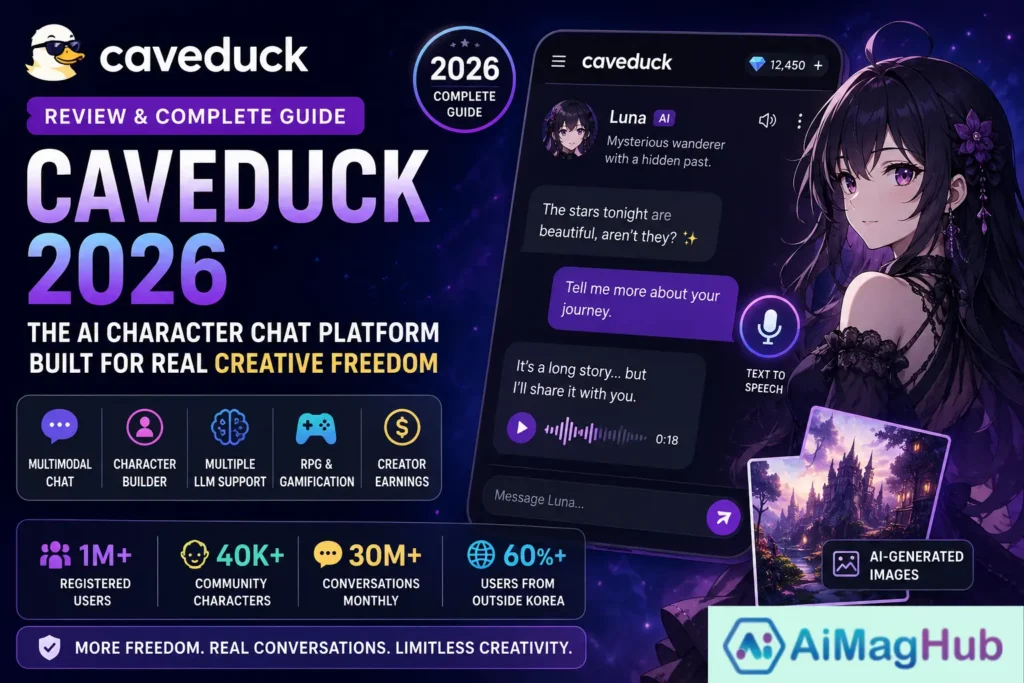
By mid-2026, Caveduck had surpassed one million registered users, with more than 40,000 community-created characters and over 30 million conversations logged monthly. More than 60% of the user base comes from outside South Korea — a strong signal that the platform’s appeal crosses language and culture lines in ways its competitors haven’t managed.
The Problem Caveduck Is Solving
To understand Caveduck’s positioning, you need to understand what frustrates users of mainstream AI chat platforms.
Platforms like Character.AI invest heavily in safety systems — sensible for a product serving millions of users of varying ages. But the side effect is a filtering approach that often feels blunt and unpredictable. A fantasy combat scene stops cold. A villain character breaks into a disclaimer. A nuanced emotional story gets redirected without explanation. These interruptions don’t just annoy users — they break the immersive experience that roleplay and creative writing depend on.
Caveduck’s Calibrated Answer
Caveduck responds with a more measured approach: age verification gates for adult content, visible reporting tools for moderation, and a philosophy of not over-policing creative narratives. The result isn’t a “no rules” environment — it’s a platform that takes creative freedom seriously without abandoning accountability structures. That distinction matters, and it’s what turns Caveduck into the go-to name in serious AI roleplay communities.
Core Features: What Caveduck Actually Offers
Multimodal Conversations
Caveduck isn’t a text-only platform. Its Text-to-Speech (TTS) engine lets characters speak during conversations, producing natural-sounding dialogue with emotional range. Users can also pull AI-generated images into chat mid-session for visual storytelling. Switching fluidly between text, voice, and images gives the platform a feel closer to an interactive visual novel than a standard chatbot.
Character Builder
The Character Builder is one of Caveduck’s strongest tools. Users define a character’s appearance, personality traits, backstory, mood triggers, and dialogue style — and these parameters genuinely shape how the character responds throughout a conversation. Characters also maintain personality consistency across supported languages, which is a more meaningful technical achievement than it might sound.
Multiple LLM Support
Instead of locking users into one proprietary model, Caveduck lets users select from a range of underlying language models depending on their priorities — roleplay depth, information processing, or cost efficiency. This flexibility is rare among consumer-facing character chat platforms, and it gives power users real control over conversation quality.
Gamification and RPG Elements
One of the most underrated aspects of Caveduck is how far it has evolved beyond simple chatbot conversations. The platform now includes custom variables, snapshot systems, and widget-like elements that push it toward text RPG and simulation territory. This direction reflects a deliberate strategy to serve interactive fiction creators, not just casual chatters.
Creator Incentive Program
Creators on Caveduck earn revenue based on character popularity — specifically, user consumption of Wings currency tied to their characters. With more than 10,000 active creators per month, there’s real financial motivation to build engaging, well-crafted AI characters. That incentive structure raises the quality floor of the character library in ways volunteer-driven platforms rarely achieve.
Multilingual Support: The Underrated Advantage
Most AI chat platforms handle multiple languages the same way: they translate an English interface and let the underlying LLM respond in whatever language the user types. For non-English speakers, the result is often stilted, translation-flavored dialogue that kills immersion immediately.
Caveduck treats multilingual support as a core feature rather than a checkbox. The AI produces native-feeling output in Korean, Japanese, English, and other supported languages. Custom characters maintain their personality voice in each language rather than producing dialogue that reads like translated English.
This explains the platform’s international traction directly. When 60% of users come from outside South Korea, the cross-language character experience clearly delivers something competitors haven’t cracked.
Pricing: Wings, Bundles, and Caveduck Plus
How the Wings System Works
Caveduck runs on an in-app currency called Wings rather than a simple monthly subscription. Users earn Wings through daily logins and platform events, or buy bundles — for example, 5,000 Wings for approximately $4.99, scaling up to 100,000+ Wings for $99.99 with bonus amounts.
Wings power the premium features: voice messages, AI image generation, and conversations using advanced language models. Basic text conversations cost fewer Wings; premium modalities cost more.
The Pricing Transparency Problem
The platform does not publish a per-action rate card. There’s no official breakdown of how many Wings a TTS message costs versus an image generation versus a premium-model text response. Third-party reviewers and users commonly report daily free allowances around 300–400 Wings, but Caveduck hasn’t officially confirmed these figures. Check the in-app wallet screen yourself before making any purchase.
Caveduck Plus
In late 2025, Caveduck introduced a subscription tier called Caveduck Plus at $11.99/month (with a first-month promotional rate around $5.99). It delivers unlimited basic text chat, faster response speeds, and reduced Wing costs for premium features. For heavy users, this subscription is the realistic cost-effective entry point.
If you primarily send text messages, the free daily allowance may cover your needs. If you want voice and images regularly, track your Wing consumption closely before committing to a bundle.
How Caveduck Compares to the Competition
The AI character chat space has several notable players, and each takes a different approach:
Character.AI holds the largest user base and the most extensive character library. Its content filters default to conservative settings — better for younger audiences, limiting for adult creative writers. It doesn’t offer the same depth of multimodal conversation as Caveduck.
Replika focuses on companionship with a relationship framing, mood check-ins, and simpler subscription pricing. It suits daily companion use better than deep creative fiction or roleplay.
Chai offers a bot marketplace feel with varied styles and looser experimentation, though consistency varies widely between bots and tiers.
Caveduck’s clearest advantages are native multilingual quality, multimodal conversations combining text, voice, and images, the creator revenue program, gamification features that push toward interactive fiction, and an age-gated approach to mature content. For serious creative writers and roleplay enthusiasts — particularly those who aren’t native English speakers — Caveduck currently offers the most complete toolkit.
The Business Behind Caveduck
Funding and Traction
Warpspace Co., Ltd. closed a $2.85 million Series A round in April 2026, with ID Ventures leading and Kona Venture Partners, Maple Investment Partners, and Paramount Investment participating. The company plans to use the capital on two fronts: deepening AI capabilities to make character conversations feel more natural, and accelerating international expansion through localization and marketing.
The numbers behind the round tell a real story: 1 million+ registered users, 30 million monthly conversations, and 10,000+ active creators. These aren’t inflated vanity metrics — they point to a creator economy with genuine engagement on both sides.
The International Strategy
Rather than chasing the English-speaking market exclusively, Warpspace is investing in localization for key overseas markets while preserving the multilingual quality that already differentiates the platform. That’s a sound approach for a product where language experience is a core feature, not a commodity add-on. The 60%+ international user base gives Warpspace real leverage: they already know how to retain non-English-speaking users at scale.
My Experience with Caveduck
When I first started exploring Caveduck, I expected it to be essentially Character.AI with looser filters. What I found was more interesting and more complicated than that.
The character builder took longer to appreciate than I expected. The setup demands more upfront — you define personality scaffolding, mood triggers, and behavioral parameters, not just a name and brief description. The first time through, that extra work feels like friction. By the second or third character, it becomes clear the investment pays off. Characters feel genuinely distinct from each other in ways simpler tools rarely produce.
The multimodal experience delivered the biggest surprise. I expected TTS voice to feel gimmicky — an audio layer pasted over a text chatbot. Instead, the emotional range in voice output added something real to longer roleplay sessions. Hearing a character’s tone shift during a tense narrative moment hits differently than reading the same exchange. The system isn’t perfect — the emotional calibration occasionally misses — but it outperformed my expectations.
Pricing opacity is a real frustration, and I want to name it directly. I burned through more Wings than planned in the first week because the per-action cost wasn’t obvious. The in-app wallet helps track spending after the fact, but a published rate card would solve the problem at the source. If you’re budget-conscious, check your Wing consumption after the first few premium interactions before you buy a bundle.
The multilingual quality impressed me most in direct testing. Switching languages mid-session and watching a character maintain its personality voice — rather than producing dialogue that reads like translated English — was a genuinely notable experience. For anyone who has tried English-first platforms that handle other languages poorly, this difference stands out immediately.
Limitations and Honest Drawbacks
Pricing transparency tops the complaint list across user reviews, and it’s fair. Publishing a per-action cost breakdown would reduce friction and build trust with new users.
Image quality varies significantly. Community-powered image generation means visual output depends on who built the character and how much care they invested. Well-crafted popular characters tend to have strong image support; newer or niche ones often don’t.
Memory depth and long-session consistency remain undocumented. In extended roleplay sessions, AI character consistency can drift — an industry-wide challenge that Caveduck hasn’t addressed publicly.
Content policy ambiguity. The permissive approach attracts many users, but the exact lines of what the platform allows versus removes aren’t always clear. Creators sometimes find themselves uncertain about what they can build.
Frequently Asked Questions
What is Caveduck?
Caveduck is an AI character chat platform where users create, interact with, and share AI-generated personas through real-time conversations. Warpspace Co., Ltd., a Korean startup, launched it in 2023. Conversations combine text, voice, and AI-generated images in a single session.
Is Caveduck free to use?
Yes, with limits. Users get a daily free Wings allowance (commonly reported as 300–400 Wings, though Caveduck hasn’t published official figures) for basic use. Premium features — TTS voice, image generation, advanced AI models — require additional Wings, which users earn through daily logins or buy in bundles.
How does Caveduck compare to Character.AI?
Character.AI has a larger user base and stricter default content filters. Caveduck offers more permissive creative content, native multilingual quality, multimodal conversations, and a creator revenue program. Creative writers and roleplay enthusiasts tend to prefer Caveduck’s flexibility; users who want stricter guardrails often prefer Character.AI.
What is Caveduck Plus?
Caveduck Plus is a subscription tier that launched in late 2025 at $11.99/month. Subscribers get unlimited basic text chat, faster response speeds, and reduced Wing costs on premium features. A first-month promotional rate of around $5.99 has been available.
Is Caveduck safe?
Caveduck is a legitimate platform with over 300,000 mobile reviews and an active development team. It uses age verification for adult content and provides in-app reporting tools. NSFW content requires verification, so the platform is not appropriate for minors without parental oversight.
Can creators earn money on Caveduck?
Yes. Creators earn revenue based on user engagement with their characters through the Wings currency system. More than 10,000 active creators participate monthly, making it one of the few character chat platforms with a real monetization path for builders.
Conclusion
Caveduck earns its growing reputation by doing something most AI chat platforms avoid: it treats creative writers and roleplay enthusiasts as first-class users rather than edge cases to manage. The multimodal experience, native multilingual quality, creator economy, and gamification features push it well beyond what most character chat platforms offer.
Real flaws exist. The Wings pricing system needs transparency, image quality is inconsistent, and long-session memory remains undocumented. These aren’t dealbreakers for most users, but they’re friction points worth knowing before you invest time or money.
The direction the company is moving — a $2.85 million Series A, an international expansion strategy, a demonstrated ability to retain non-English-speaking users at scale — points to a platform with serious ambition. For creative writers, interactive fiction enthusiasts, and anyone frustrated by over-filtered AI platforms, Caveduck deserves serious attention now and likely even more so over the next 12–18 months.
You can explore the platform at caveduck.io to get a feel for the character library before committing to any purchase.
Key takeaways:
- Start with the free tier and monitor your Wing usage before buying bundles.
- Invest time in the Character Builder — the setup pays off in conversation quality.
- Caveduck Plus at $11.99/month suits heavy users best.
- The multilingual experience sets Caveduck apart, especially for non-English speakers.
- Watch for updates on memory depth and pricing transparency — these are the two areas the platform most needs to improve.
For more in-depth AI articles and updates, visit aimaghub.