Introduction: The Automation Gap Most Businesses Don’t Know They Have
There’s a moment every operations manager eventually hits — you’re staring at a spreadsheet that took four hours to compile, and somewhere in the back of your mind you’re thinking, there has to be a better way. That feeling isn’t just frustration. It’s a signal that your business is leaving productivity on the table.
Droven.io AI automation tools have entered this conversation at exactly the right time. As artificial intelligence moves from hype-driven novelty into genuine utility, platforms like Droven.io are helping businesses, developers, and operators understand what to automate, how to approach it intelligently, and which tools are actually worth deploying. In 2026, the global AI market is tracking toward $1.5 trillion by 2030, and the companies winning right now aren’t necessarily the ones with the biggest budgets. They’re the ones making smarter, better-informed automation decisions.
This guide breaks down everything you need to know about Droven.io AI automation tools — how the platform works, where it delivers real value, who it’s built for, and how to use it as a launchpad for serious operational change.
What Is Droven.io and Why Does It Matter?
Before diving into specific tools and workflows, it’s worth being clear about what Droven.io actually is, because it’s often mischaracterized.
Droven.io is best described as an editorial AI knowledge and automation hub — not a SaaS product vendor or a marketplace full of demo funnels. Its core value is helping business owners, operations managers, developers, and learners understand AI and automation before they commit budget to tools or implementation. That distinction matters enormously, because most automation failures don’t happen at the execution stage. They happen much earlier, when teams buy tools they don’t fully understand for problems they haven’t clearly defined.
The platform covers a broad range of topics including workflow automation, robotic process automation (RPA), no-code and low-code platforms, machine learning applications, cloud infrastructure, and cybersecurity. Its content is deliberately written in accessible language — complex enough to be useful, but structured so that a non-technical business owner can follow along without needing an engineering degree.
The Problem Droven.io Is Actually Solving
Here’s what most AI content misses: the bottleneck for most businesses isn’t access to automation tools. It’s the understanding required to use them well. Teams buy Zapier, UiPath, or Make.com licences, set up three workflows in the first week, then quietly abandon the platform six months later because they never had a clear strategy going in.
Droven.io exists in that gap — helping people develop the kind of grounded understanding that makes vendor demos less confusing, implementation decisions more defensible, and automation investments actually stick.
Core Areas Covered by Droven.io AI Automation Tools
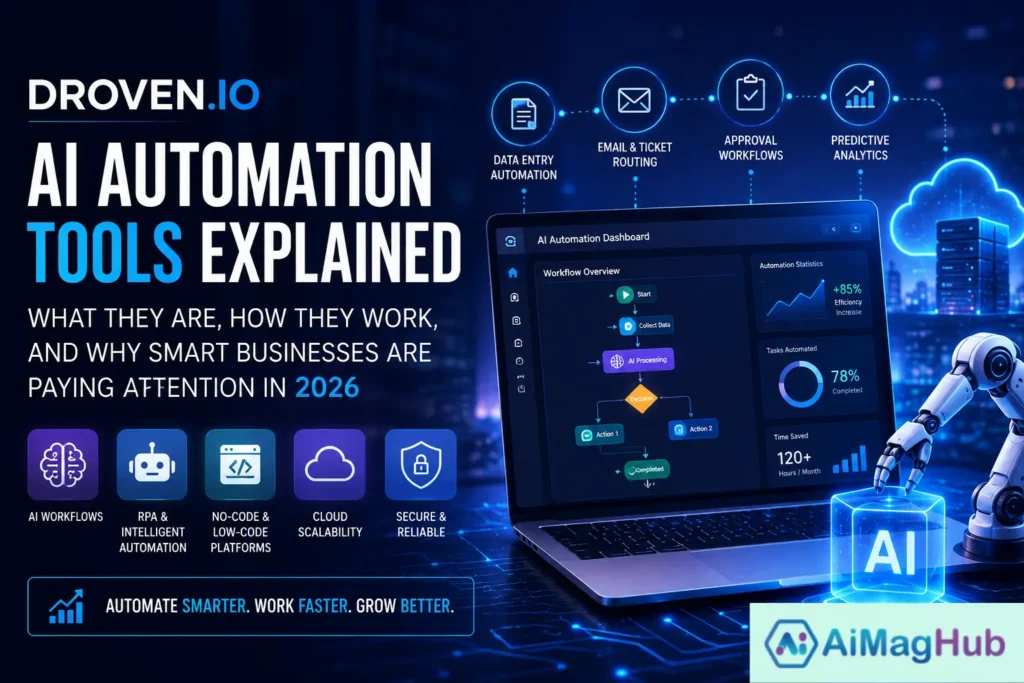
1. Workflow Automation and Intelligent Process Design
The foundation of any serious automation strategy is workflow design. Droven.io covers this topic with depth, walking readers through the difference between rule-based automation (where a fixed sequence of steps is triggered by a specific condition) and AI-driven dynamic workflows that adapt based on real-time data patterns.
The practical implication is significant. Traditional RPA tools automate tasks. More advanced AI automation tools — the kind Droven.io profiles and explains — automate the thinking behind those tasks. That includes decision automation, predictive routing, and self-optimizing processes that improve over time without manual reconfiguration.
Common automation use cases covered include:
- Data entry automation and validation
- Invoice and billing processing
- Email management and intelligent ticket routing
- Approval workflows and escalation logic
- Demand forecasting and inventory management
- Customer communication sequences
2. Robotic Process Automation (RPA) in the Real World
Droven.io’s RPA content is some of its most practically useful. Rather than giving you a textbook definition, the platform explains how RPA actually behaves inside business environments — including where it breaks down.
For instance, traditional RPA is brittle. Change a screen layout or rename a field in your ERP system, and your bot stops working. AI-enhanced RPA — sometimes called intelligent automation or hyperautomation — is more resilient because it uses computer vision and natural language processing (NLP) to interpret interfaces contextually rather than relying on fixed coordinates.
Understanding this distinction has saved more than a few teams from buying an expensive RPA licence for a use case that needed something smarter.
3. No-Code and Low-Code Automation Platforms
One of the areas where Droven.io genuinely shines is its coverage of no-code and low-code tools. This is the space most accessible to small and mid-sized businesses, and it’s evolving fast.
Platforms like Make.com, n8n, and Microsoft Power Automate have democratized automation in ways that would have seemed impossible five years ago. Droven.io helps readers understand how to evaluate these platforms honestly — what they’re good at, where they hit limitations, and when it makes sense to graduate to more sophisticated infrastructure.
4. Machine Learning Use Cases Across Industries
Beyond workflow tools, Droven.io covers how machine learning is being applied across sectors including healthcare, finance, marketing, and logistics. This isn’t abstract theory — it’s grounded in real-world use cases like:
- Predictive analytics for inventory and demand forecasting
- Fraud detection and expense categorization in financial operations
- AI-assisted customer service including sentiment analysis and intelligent handoff
- Generative AI for content and marketing workflow acceleration
- Compliance automation in regulated industries
5. Cloud Infrastructure and Scalability
Automation doesn’t run on goodwill — it runs on infrastructure. Droven.io’s cloud computing content explains how modern AI automation tools scale globally using cloud-native architecture, and what businesses need to understand about SaaS deployment models before signing contracts.
Who Is Droven.io Built For?
Based on the depth and framing of the content, a few audience types stand out as particularly well-served by the platform:
Operations managers evaluating automation tools — the platform gives you enough context to evaluate vendor claims critically and push back on demos that overpromise.
Business owners starting their automation journey — the no-jargon approach and use-case framing make complex topics accessible without dumbing them down to the point of uselessness.
Developers and technical professionals — there’s career guidance covering programming skills, API insights, AI career paths, and how to position yourself in emerging roles like prompt engineering and automation strategy.
Consultants advising SMEs on digital transformation — the neutral, non-promotional perspective makes it a useful reference that won’t bias client recommendations toward specific vendors.
Benefits of Using Droven.io as Your Automation Education Layer
Clarity Before Commitment
Most automation failures are strategic, not technical. Teams that start by reading Droven.io content before entering vendor conversations tend to ask sharper questions, identify their actual constraints earlier, and avoid the classic trap of automating a broken process and getting a faster broken process.
Reduced Vendor Dependency
When you understand the underlying concepts — what RPA can and can’t do, how ML models actually learn, what cloud scalability really means — you’re no longer fully dependent on vendor sales teams to frame your options. That’s a meaningful shift in leverage.
Faster Decision-Making
There’s a real cost to analysis paralysis. Droven.io’s structured, use-case-first content helps teams move from “we should probably look into automation” to “here’s our specific workflow, here’s the class of tool that fits, here’s our evaluation criteria” — significantly faster than if they were piecing it together from product documentation and YouTube tutorials.
Common Mistakes When Adopting AI Automation Tools
Even with good information, teams make predictable errors. Here are the ones worth avoiding:
Starting without a defined use case. Automation for its own sake is waste disguised as progress. Know exactly which process you’re optimizing before you evaluate a single tool.
Ignoring data quality. AI automation tools are only as good as the data feeding them. If your CRM is full of duplicates and your inventory system hasn’t been reconciled in three years, no automation platform will save you.
Underestimating change management. Technology is the easy part. Getting people to actually use new systems — and trust them — is where most automation projects stall.
Choosing complexity over fit. A no-code tool that your team actually uses will outperform a sophisticated ML pipeline that nobody understands. Start with the right level of complexity for your current maturity.
Skipping the ROI conversation. Automation has costs — licences, implementation time, maintenance, training. Be honest about the full picture before you commit.
Best Practices for Getting Value from AI Automation in 2026
- Map your processes before you automate them. Write out the steps, identify decision points, and flag where human judgment is genuinely required.
- Prioritize high-volume, low-complexity tasks first. These deliver the fastest ROI and build internal confidence.
- Build a feedback loop. Automation should improve over time. Set up monitoring, review errors regularly, and iterate.
- Treat your automation layer as infrastructure. Document it, version-control it, and assign ownership.
- Use education platforms like Droven.io to stay current. The tooling changes fast. Regular reading keeps you oriented without requiring you to test everything yourself.
Personal Experience: What I Learned After Six Months of Exploring AI Automation
I’ll be honest — when I first started looking into AI automation tools, I made most of the mistakes listed above. I signed up for three platforms simultaneously, built workflows that solved problems I didn’t really have, and spent more time watching demo videos than actually shipping anything useful.
What changed things was finding content that treated me like someone capable of understanding the why behind automation decisions, not just the how. Droven.io was part of that shift. The RPA content in particular helped me understand why my first attempt at automating a data extraction task kept breaking — I was using a rule-based approach for a dynamic interface, and no amount of tweaking was going to fix a fundamentally wrong tool choice.
Once I started with the use case and worked backwards to the technology, everything got clearer. I mapped three specific workflows where manual effort was genuinely high and error rates were measurable. I picked a single no-code automation tool, built one workflow properly, and measured the result before touching anything else.
The time savings were real — roughly six hours per week on a process that previously required daily manual intervention. But more importantly, the confidence that comes from understanding what you’re building and why it works is something no product demo can give you. That comes from education first, implementation second.
The lesson: don’t skip the understanding layer. Platforms that help you think clearly about automation before you act on it are worth your time, especially in a space where hype moves faster than substance.
Frequently Asked Questions
What exactly is Droven.io?
Droven.io is an editorial AI knowledge and automation platform that publishes in-depth educational content on topics including workflow automation, RPA, machine learning, cloud computing, and cybersecurity. It functions as an education layer for businesses and professionals exploring AI adoption — not as a software vendor or tool marketplace.
Is Droven.io a paid platform?
Based on current information, Droven.io operates as a free, US-focused AI knowledge hub. Its value comes from the quality and depth of its educational content rather than gated features or subscription tools.
What types of AI automation tools does Droven.io cover?
The platform covers a broad range — from no-code workflow tools like Make.com and Power Automate to enterprise RPA platforms, AI-driven predictive analytics systems, NLP-based customer service automation, and generative AI applications in marketing and operations.
How is Droven.io different from just reading vendor documentation?
Vendor documentation explains how to use a specific product. Droven.io explains how to think about automation decisions — which tools fit which problems, what the trade-offs are, and how to evaluate vendor claims critically. That’s a different and arguably more valuable type of knowledge, especially when you’re pre-purchase.
Can small businesses benefit from Droven.io AI automation content?
Absolutely. In fact, small and mid-sized businesses arguably benefit most, because they typically don’t have dedicated IT departments or automation consultants to guide decisions. The no-jargon, use-case-first approach makes the content accessible to operators without technical backgrounds.
What industries are most covered in Droven.io’s AI automation content?
The platform covers AI and automation applications across healthcare, finance, marketing, logistics, retail, education, and general business operations. The breadth reflects the reality that automation opportunities exist across virtually every sector.
How should I use Droven.io alongside actual automation tools?
Use Droven.io as your strategy and education layer — to clarify use cases, understand tool categories, and prepare better questions before entering vendor conversations. Then move into discovery, prototyping, and implementation with a clear goal. The McKinsey Global Institute and other research bodies consistently show that organizations with clear automation strategies before tool adoption see significantly better outcomes.
Conclusion: Understand First, Automate Second
The conversation around AI automation has matured. We’re past the phase where “we’re using AI” was enough to impress a board or justify a budget line. In 2026, the question isn’t whether to automate — it’s whether you’re automating the right things, with the right tools, in the right sequence.
Droven.io AI automation tools content positions itself squarely in that more sophisticated conversation. Whether you’re an operations manager evaluating your first RPA deployment, a developer building out intelligent workflows, or a consultant helping a client navigate their digital transformation roadmap, the platform offers a grounded, non-promotional resource for making better decisions faster.
Actionable takeaways:
- Identify one high-volume, manual process in your current workflow and research its automation options using platforms like Droven.io before approaching vendors
- Learn the difference between rule-based RPA and adaptive AI automation — your use case will determine which you actually need
- Treat automation education as ongoing infrastructure, not a one-time activity
- Start small, measure carefully, and scale what works
- Use the Droven.io RPA and workflow content as a pre-vendor checklist before committing to any platform
Automation isn’t a shortcut. But with the right understanding behind your decisions, it’s one of the most reliable levers for sustainable business growth available right now.
For more insightful articles, expert reviews, and the latest updates on AI, automation, and emerging technologies, visit AimagHub.