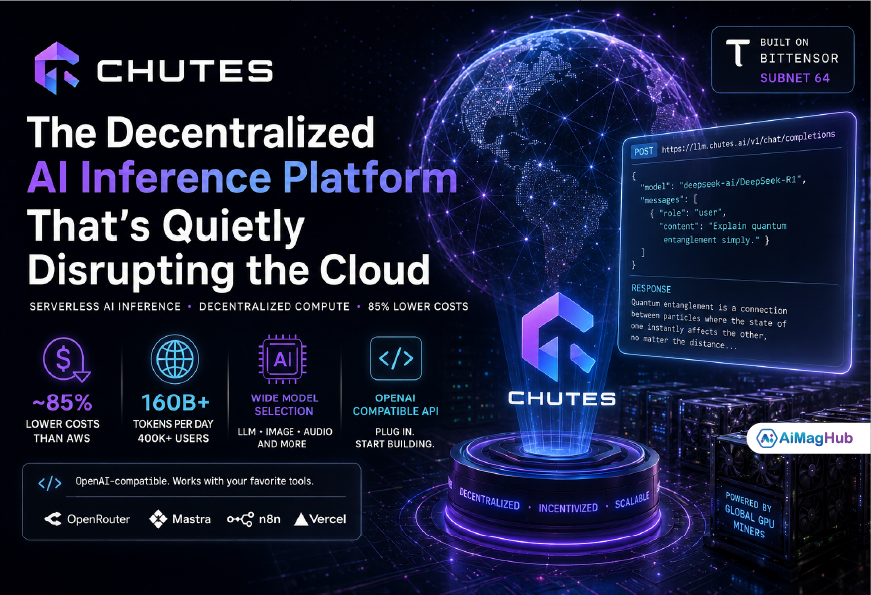
If you’ve been paying attention to the AI developer space lately, you may have started seeing the name Chutes pop up — on OpenRouter, in Bittensor forums, in developer Discords. And honestly, it’s not hard to see why. The Chutes API is one of the most interesting new entrants in the AI compute space, offering serverless AI inference on a decentralized, Web3-powered infrastructure at a fraction of what you’d pay on AWS or Azure. It’s fast, its surprisingly affordable and it’s growing at a rate that most developers didn’t expect from a crypto-native product.
So what exactly is the Chutes API, how does it work, and is it worth integrating into your stack? Let’s dig in.
What Is the Chutes API?
At its core, the Chutes API is an on-demand AI inference service that lets developers deploy, run and scale AI models — large language models, image generators, audio models, and more — without managing any infrastructure. You write your code, point it at an API endpoint and it just… runs. No Kubernetes clusters, no spinning up EC2 instances, no DevOps headaches.
What makes Chutes distinct from something like OpenAI’s API or Replicate, is where that compute comes from. Chutes is built on Bittensor’s Subnet 64, a decentralized network where GPU “miners” contribute their hardware to serve inference requests. Developers get a clean, standard REST API while behind the scenes a network of H200s and A6000s distributed around the world does the heavy lifting.
The platform was developed by Rayon Labs and launched in late January 2025. Since then, the growth has been — to put it plainly — explosive.
Why the Chutes API Is Getting So Much Attention
1. The Cost Advantage Is Real
This is probably the most talked about thing about Chutes and its not exaggerated. Because the platform taps a decentralized network of GPU providers compensated through TAO token micropayments, it doesn’t carry the overhead of traditional cloud providers. Analyses suggest Chutes’ inference costs run roughly 85% lower than AWS for comparable workloads. Even after Chutes introduced paid tiers for certain models in April 2025, it still significantly undercuts competitors, and keeps a portion of models accessible on a free or low-cost basis.
For startups, solo developers and researchers on tight budgets this kind of pricing difference isn’t a rounding error — its a business model change.
2. Scale That Speaks For Itself
Numbers matter, so here’s a few that are worth knowing. As of mid-2025, the Chutes platform was processing close to 160 billion tokens per day, serving over 400,000 users. That’s roughly a third of what Google’s entire AI inference load looked like a year earlier, according to publicly shared figures. The platform also quickly became the #1 provider on OpenRouter, the major LLM API aggregator that serves over 5 million developers across 60+ providers.
That’s not a marketing claim — it’s a measurable ranking on a neutral third-party platform.
3. Model Diversity
Chutes isn’t just about running one or two popular models. Its designed to be model-agnostic. You can run LLMs for text generation, diffusion models for image synthesis, audio and speech models, and even deploy your own custom containers with arbitrary Python code. The platform supported cutting-edge models like DeepSeek V3 before many centralized providers even had it available, which earned it a lot of goodwill from the developer community early on.
How the Chutes API Actually Works
The Architecture: Chutes, Cords and Miners
The Chutes platform has a few core concepts worth understanding before you start building:
- Chutes: These are the deployable applications — essentially containerized AI workloads. Each chute gets a unique subdomain (e.g.,
username-modelname.chutes.ai) that becomes its public API endpoint. - Cords: These are the individual callable functions within a chute. Think of them as the specific API routes your chute exposes. Each cord auto-generates an OpenAPI schema for clean REST integration.
- Miners: The distributed GPU operators who actually execute the inference. Miners are scored on compute capacity (55%), speed (20%), availability (20%), and bounties (5%) over rolling 7-day windows — so there’s a real incentive to stay performant.
Validators on the network audit the miners’ outputs to ensure quality and fairness. It’s a fully incentivized system, not just a trust-based one.
Authentication and Getting Started
Getting started with the Chutes API is fairly standard stuff. You sign up at chutes.ai/app, generate an API key (cpk_...), and you’re ready to go. The base API endpoint for LLM inference is:
https://llm.chutes.ai/v1/chat/completions
This endpoint is OpenAI-compatible, which is a big deal practically speaking. It means you can swap in Chutes as a drop-in replacement in any application already built on the OpenAI SDK or any other tool using the standard /v1/chat/completions format — including Mastra, n8n, Vercel SDK and more.
Here’s a minimal example of what a request looks like:
import openai

client = openai.OpenAI(
    base_url="https://llm.chutes.ai/v1",
    api_key="YOUR_CHUTES_API_KEY"
)

response = client.chat.completions.create(
    model="deepseek-ai/DeepSeek-R1",
    messages=[{"role": "user", "content": "Explain quantum entanglement simply."}]
)
print(response.choices[0].message.content)
It’s that simple. No new SDK to learn, no proprietary format to adapt to.
Deploying Your Own Models
If you want to go beyond the pre-deployed models and run your own, the Chutes SDK (installable via pip install chutes) gives you a Python-native workflow for:
- Building a custom Docker image using the
chutes.image.Imageclass - Deploying the image as a chute with
chutes deploy - Sharing or monetizing your deployment with other users
The platform uses parachutes/python:3.12 as its recommended base image, which includes Python 3.12 and all the CUDA packages you’d need for GPU workloads. All image builds happen remotely on Chutes’ infrastructure, so you don’t need a GPU-equipped machine to build and push.
There is a deployment fee involved (shown before confirmation as a safety check), and you’ll need at least a $50 balance to build images. But for production workloads that would otherwise cost significantly more on centralized clouds, this is a reasonable entry point.
Chutes API vs. Other Inference Providers
Let’s be honest about where Chutes fits relative to alternatives.
| Feature | Chutes API | OpenAI API | Replicate | AWS Bedrock |
|---|---|---|---|---|
| Infrastructure | Decentralized (Bittensor) | Centralized | Centralized | Centralized |
| Relative Cost | ~85% cheaper than AWS | Mid-range | Mid-range | High |
| Open Source Models | ✅ Wide selection | ❌ Mostly proprietary | ✅ Good selection | ✅ Some |
| OpenAI-compatible API | ✅ Yes | ✅ Native | ❌ Different format | ❌ Different format |
| Custom Deployments | ✅ Yes | ❌ No | ✅ Yes | Limited |
| Privacy / TEE | In roadmap (live for some) | No | No | Some |
| Pay-per-use | ✅ Token/step billing | ✅ Token billing | ✅ Per-run billing | ✅ Token billing |
The headline trade-off is pretty clear: Chutes wins significantly on cost and model diversity, but centralized providers like OpenAI still offer more polished developer tooling, enterprise SLAs and guaranteed uptime guarantees that decentralized infrastructure can’t always match. That said, for developers who are building on open-source models and care about cost — Chutes is hard to ignore.
Real-World Use Cases and Integrations
AI Agents and Automation
Chutes has built out a Squad API for running multi-agent workflows on top of its compute layer. Autonomous agents can route inference calls through Chutes using TAO tokens, making it one of the few platforms where AI agents are actually making real micropayments for compute — not just simulating it.
This is a genuinely new pattern. One integration that demonstrated this was with Moltbot, where autonomous agents were reportedly purchasing decentralized AI inference at costs up to 96% lower than OpenAI equivalents.
Developer Tool Integrations
Chutes is now natively supported on several major developer platforms:
- OpenRouter — where Chutes ranks as the #1 provider
- Mastra — 70+ Chutes models accessible via the
CHUTES_API_KEYenvironment variable - TypingMind — plug-and-play integration for custom model chats
- Vercel SDK and n8n — expanding Chutes into mainstream developer tooling
These aren’t marginal integrations. They’re the primary entry points for millions of developers who may have no idea they’re running on Bittensor infrastructure when they hit a Chutes endpoint.
Startups and Research
Chutes runs a startup accelerator program offering up to $20,000 in compute credits, which is a meaningful offer for early-stage teams building on open-source AI. Given that compute costs can become a significant limiting factor for pre-revenue startups, this kind of support — and the underlying cost structure of the platform — makes Chutes a genuinely attractive choice for those early stages.
The Bittensor Connection: Understanding the Bigger Picture
You can’t talk about the Chutes API without at least briefly touching on Bittensor. Bittensor is a decentralized AI network where participants earn TAO tokens by contributing compute or other AI services. Chutes operates as Subnet 64 within this ecosystem, and it’s currently the #1 subnet by emissions.
In February 2025, Bittensor transitioned to a system called Dynamic TAO (dTAO), which made each subnet’s share of daily TAO emissions market-driven. Chutes has benefited enormously from this — its real-world usage and revenue have made it one of the most credible subnets in the ecosystem.
Rayon Labs, the team behind Chutes, also operates two other subnets: Gradients (SN56) for model training and Nineteen (SN19) for high-frequency inference. Together, this “Rayon Trio” controls roughly 23.7% of all daily TAO emissions — making Rayon Labs arguably the most influential development group in the entire Bittensor ecosystem.
For users who hold TAO or want to interact with Bittensor natively, Chutes also offers free access and developer-role status for validated Bittensor subnet owners — a nice touch that rewards the existing community.
Pros and Cons of the Chutes API
✅ Pros
- Significantly cheaper than centralized cloud inference (up to 85-90% savings)
- OpenAI-compatible API — minimal migration effort from existing projects
- Huge model library — LLMs, image, audio, speech and video models all available
- Custom deployments — bring your own models and code via Docker containers
- Strong integrations — OpenRouter, Mastra, n8n, Vercel SDK and more
- Transparent, pay-per-use pricing — no surprise bills or locked contracts
- Open source codebase — GitHub repo is public and auditable
❌ Cons
- Decentralized infrastructure — less predictable uptime than centralized cloud SLAs
- Validator concentration — main validator is operated by Rayon Labs, which is a centralization risk
- Crypto-adjacent complexity — TAO token mechanics, wallet setup etc. adds friction for non-Web3 users
- Minimum balance requirement — need $50+ to build custom images
- Still maturing — some roadmap features (TEE for all models, fine-tuning) not yet fully live
Security and Privacy Features
One of the more forward-looking aspects of Chutes is its commitment to privacy-preserving compute. The platform has been rolling out Trusted Execution Environments (TEE) for select models — isolated compute environments where inference happens in encrypted, tamper-proof containers that even the platform operators can’t inspect. This matters a lot for regulated industries like healthcare, legal, or finance, where data sovereignty isn’t optional.
The platform is also designed with decentralization as a core privacy principle. As the Chutes blog puts it, decentralized AI systems enable organizations to process and analyze data across distributed networks — enhancing privacy, scalability and resilience without relying on a single point of control.
For developers handling sensitive data, this architecture is increasingly relevant as regulators start paying closer attention to where AI workloads actually run.
Tips for Getting Started With the Chutes API
- Start with the LLM endpoint —
https://llm.chutes.ai/v1/chat/completionsis the easiest entry point if you’re already using an OpenAI-compatible SDK. - Monitor your usage — Head to chutes.ai/app/api/logs to track token consumption and set spending limits before they become a surprise.
- Use OpenRouter for model discovery — If you want to browse Chutes models alongside other providers, OpenRouter is a good neutral aggregator.
- Read the SDK docs before deploying custom models — The Chutes documentation is well-organized with working examples for LLM chat, image generation, audio processing, embeddings and more.
- Check the cost optimization guide — Chutes provides a dedicated cost optimization guide that explains how to reduce spend on different workload types.
- Join the Bittensor community if you want miner-level access or to link an existing on-chain identity for free developer access.
Frequently Asked Questions
Is the Chutes API free to use?
The platform was fully free during its early adoption phase in early 2025. As of April 2025, some models require payment, but many remain free or very low cost. You pay per token for LLMs, per step for diffusion models, or per second for other chute types.
Do I need to understand Bittensor or crypto to use Chutes?
Not really, for most use cases. You can sign up, add a credit card balance and use the API like any other provider. The TAO token layer operates in the background — you don’t have to touch it unless you want to.
Is the Chutes API OpenAI-compatible?
Yes. The LLM endpoint (https://llm.chutes.ai/v1) uses the standard /chat/completions format and is drop-in compatible with any OpenAI SDK.
What models are available?
Chutes supports a wide and growing library including DeepSeek models, Llama variants, Mistral models, and many others. You can browse the current list at chutes.ai/app or via the OpenRouter provider listing.
Can I deploy my own custom model?
Yes. Using the Chutes SDK and CLI, you can build custom Docker images and deploy arbitrary AI applications. The platform supports any Python-based model that can run in a container.
How does Chutes handle data privacy?
Chutes uses a decentralized architecture by design, and is rolling out Trusted Execution Environments (TEE) for enhanced compute isolation. For production applications with sensitive data requirements, check the security architecture docs.
Conclusion: Should You Integrate the Chutes API?
The honest answer is: if you’re building on open-source AI models and cost is a real constraint — yes, the Chutes API is worth serious consideration. The pricing advantage is real, the OpenAI-compatible API removes friction and the scale (400,000+ users, 160B+ tokens/day) proves this is not an experimental platform anymore.
That said, its not the right fit for everything. Teams that need guaranteed SLAs, enterprise support contracts or are already locked into a cloud provider’s compliance framework will find centralized options easier to work with. And the validator concentration issue is a legitimate concern for those who care deeply about decentralization guarantees.
But for the growing number of developers who just want cheap, fast, model-diverse AI inference without the cloud bill — Chutes is increasingly hard to overlook. It was the first to ship DeepSeek V3, it’s the top provider on OpenRouter and it’s built on infrastructure that structurally can’t be as expensive as a centralized cloud. That combination is pretty compelling.
Quick action steps:
- Create an account at chutes.ai/app
- Grab your API key and test the LLM endpoint in under 5 minutes
- Review the full API documentation to understand available endpoints
- Check the GitHub repo if you’re curious about the open-source underpinnings
The decentralized AI compute wave is arriving — and Chutes is currently leading the charge.
Visit: Aimaghub