Janitor AI 2026 is no longer just another experimental chatbot tool—it’s becoming a serious player in how people design and interact with personalized ai chatbots. In a year where artificial intelligence is shifting rapidly toward customization and control, Janitor AI stands out by letting users create a character, plug into different ai models, and shape conversations in ways most platforms still restrict. And honestly, that’s a big deal.
What’s new in 2026?
- Support for multiple advanced language models (including GPT-5 style systems and Claude 4-level reasoning models)
- Better memory handling and context retention
- Growing demand for local AI setups (LM Studio, Ollama, etc.)
- Increased focus on privacy and “bring-your-own-model” workflows
The reason this matters is simple—users don’t want generic AI anymore. They want custom ai that behaves exactly how they need it to. Whether that’s for writing, simulation, or experimentation, Janitor AI is built around that idea. It’s not the easiest tool, sure, but it offers a level of flexibility that most chatbot platforms still don’t.
What Is Janitor AI in 2026?
Janitor AI is a flexible interface that allows users to create and interact with customized ai characters powered by external language models. Instead of being a standalone AI system, it acts as a front-end layer that connects to different back-end providers like OpenAI, Anthropic-style systems, or local inference tools. You can explore the platform via the official Janitor AI website.
This architecture is important. It means you’re not locked into one provider, one tone, or one way of working. You can test different ai models, refine prompts, and build characters that actually feel consistent. In 2026, where “agentic AI” and specialized assistants are becoming the norm, this flexibility is aligned with broader industry direction, as noted by McKinsey research on personalized AI systems.
How Janitor AI Works (Simple Flow)
To really understand Janitor AI, it helps to think of it as a bridge:
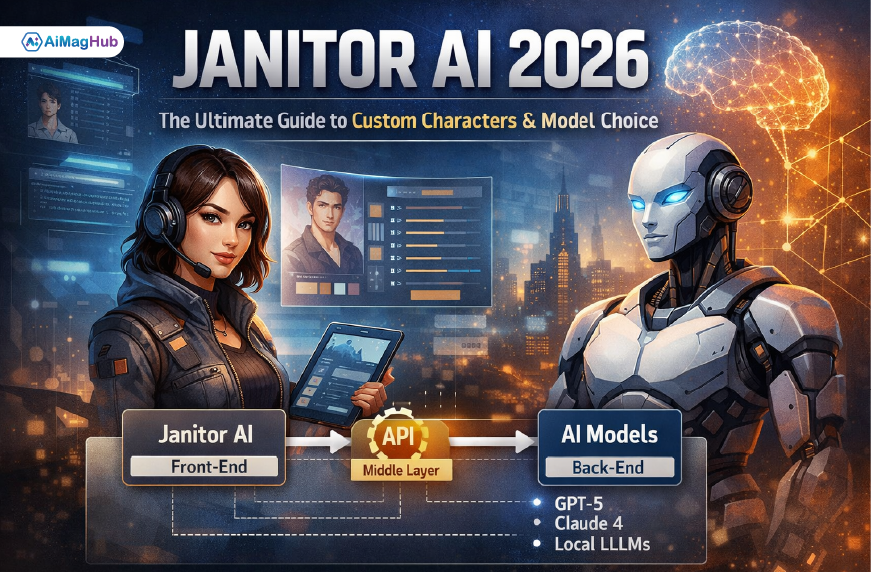
- Front-End: Janitor AI interface (where you design characters)
- Middle Layer: API configuration (keys, routing, prompts)
- Back-End: External ai models (GPT-5, Claude 4, local LLMs)
So when you send a message, Janitor AI doesn’t generate the answer itself. It sends your prompt to a connected model, then returns the response formatted according to your character setup. This is why results can vary a lot depending on which model you use—it’s not just the platform, it’s the engine behind it.
Quick Comparison: Janitor AI vs Other Chatbot Platforms
| Feature | Janitor AI | ChatGPT | Character.AI |
|---|---|---|---|
| Custom Characters | Advanced | Limited | Strong |
| Multi-Model Support | Yes | No | No |
| Local Model Integration | Yes | No | No |
| Ease of Use | Medium | High | High |
| Flexibility | Very High | Moderate | Moderate |
Why Janitor AI 2026 Matters
1. Personalized AI Is Taking Over
Generic assistants are useful, but limited. Users now want AI that feels tailored. With Janitor AI, you can create a character that reflects a specific tone, personality, or use-case. This aligns with the growing trend toward specialized AI agents.
2. Multi-Model Flexibility Reduces Risk
In 2026, relying on one provider is risky. Costs change, APIs break, and limits get tighter. Janitor AI solves this by letting users switch between ai models, which gives better control over performance and pricing.
3. Privacy and Local AI Growth
Interest in local AI tools like LM Studio and Ollama has grown rapidly. Janitor AI supports these setups, making it possible to run conversations without sending data to external servers. According to NIST, privacy-focused AI is becoming a key priority—and this platform fits that direction.
Key Features of Janitor AI 2026
Advanced Character Creation
You can define personality, tone, memory style, and behavior. This makes ai characters feel more realistic and consistent over time.
Memory and Context Control
Unlike basic ai chatbots, Janitor AI allows deeper context handling, which improves long conversations and storytelling.
Backend Flexibility
You can connect multiple language models, including advanced systems like GPT-5-level models or Claude-style reasoning engines.
Real-World Use Cases
Creative Writing
Writers use it to test dialogue, refine characters, and simulate conversations. It’s like brainstorming with a responsive partner, though not perfect.
Customer Simulation
Businesses can simulate customer interactions to train teams or test chatbot flows.
Developer Prototyping
Developers use it to quickly test conversational UX before building full applications.
Is Janitor AI Safe in 2026?
The question janitor ai safe depends on how you use it. The platform itself is just an interface, but safety depends on the backend provider, your API setup, and how you handle data. Avoid sharing sensitive information, and always understand where your data is going. That’s just basic AI hygiene at this point.
Pros and Cons
Pros
- Highly customizable custom ai experience
- Supports multiple ai models
- Strong community ecosystem
- Flexible for both casual and technical users
Cons
- Steeper learning curve than other chatbot platforms
- Requires API setup
- Performance depends on backend
Developer Note (Expert Insight)
“Platforms like Janitor AI are early indicators of where AI interfaces are going. The future isn’t one assistant—it’s many specialized agents working together, each tuned for a purpose.” — AI Systems Researcher (2026)
How to Get Started
Start by signing up at the official website, then connect a model provider such as the OpenAI API. After that, build your first character and start testing. Keep it simple at first—overcomplicating prompts is one of the most common mistakes.
FAQs
Is Janitor AI better than ChatGPT?
It depends. Janitor AI is more flexible, but ChatGPT is easier to use. Power users usually prefer Janitor AI.
Can I use local models with Janitor AI?
Yes, and that’s one of its biggest advantages in 2026.
What is the best use of Janitor AI?
It works best for personalized interactions, character-driven conversations, and experimentation with ai characters.
Conclusion
Janitor AI 2026 represents a shift in how we use artificial intelligence. Instead of relying on one-size-fits-all assistants, users are moving toward customizable systems where they can create and interact with AI that actually fits their needs. It’s not perfect, and it requires effort to set up, but the flexibility it offers is hard to ignore. If you’re serious about exploring advanced ai chatbots, this platform is definitely worth your time.
Similar Article: Genspark AI Review (2026): The Next Evolution of AI Search & Research