
Artificial intelligence isn’t just reshaping industries — it’s quietly unlocking entirely new business models. One of the most practical (and often misunderstood) among them is AI arbitrage.
At its core, AI arbitrage is about spotting the gap between what AI tools can actually do and what most businesses think they can do — and then turning that gap into profit.
It’s not a get-rich-quick trick. It’s not passive income either, not really. But if you approach it like a real business, it can become a scalable and surprisingly sustainable income stream in 2026 and beyond.
What Is AI Arbitrage? (Simple Definition)
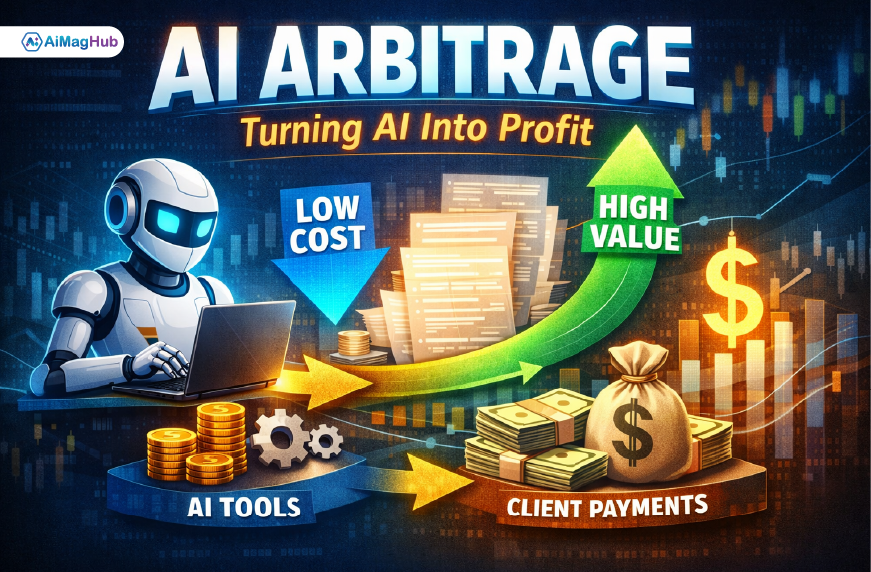
AI arbitrage is the process of using AI tools to complete work at a lower cost (time, money, effort), and then selling that output at a higher value.
In simple terms:
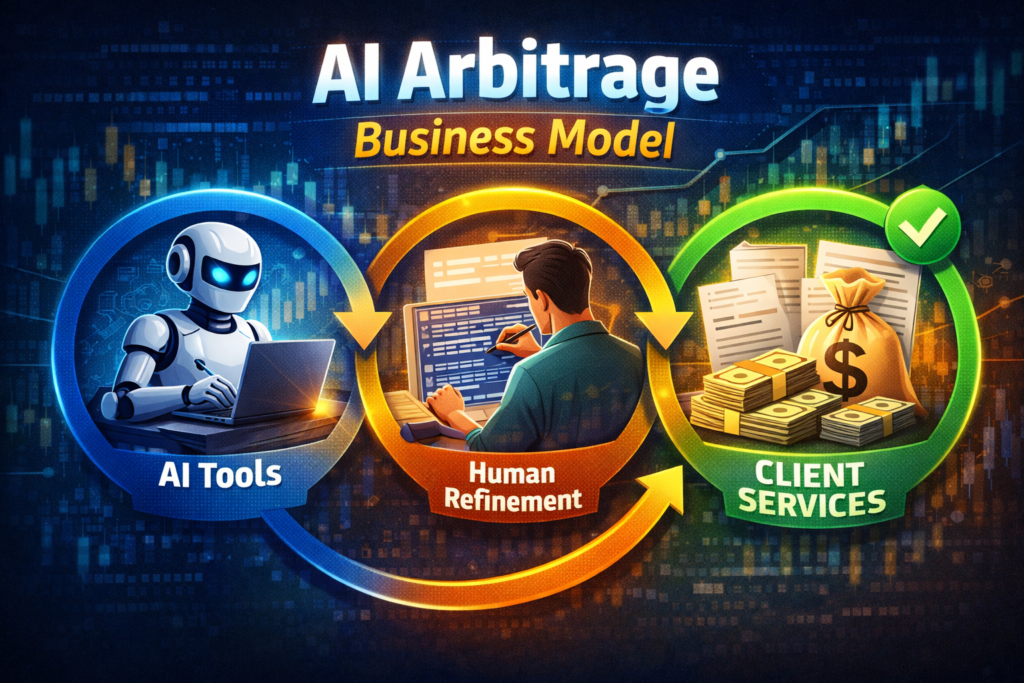
- You use AI to reduce effort or production cost
- You enhance the output with human input
- You sell the final result as a service or product
👉 Think of it as a modern version of drop-servicing with AI.
For example:
- Use AI to draft blog content → refine it → sell content packages
- Automate marketing workflows → charge monthly retainers
- Build small AI-powered tools → monetize via subscriptions
The real value comes from the execution layer, not the tool itself.
Why AI Arbitrage Matters Right Now
We’re in a rare window where AI capabilities are growing faster than user understanding.
According to the World Economic Forum and reports like the Future of Jobs Report, a significant percentage of companies are rapidly adopting AI technologies — yet many still lack the in-house expertise to implement them effectively.
Similarly, research from McKinsey & Company shows generative AI could add trillions of dollars to the global economy, especially in areas like marketing, customer service, and software development.
Here’s why that matters:
1. There’s Still a Knowledge Gap
Businesses know AI is important, but don’t know how to use it properly.
2. Tools Are Accessible
Platforms like OpenAI and Zapier have made powerful automation and content generation tools available to almost anyone.
3. Demand Is Growing Fast
Companies are actively looking for:
- AI-powered marketing
- Content creation
- Automation systems
- Data-driven workflows
This demand + confusion = opportunity.
How to Start an AI Arbitrage Business (Step-by-Step)
Step 1: Identify a Profitable Niche
Look for problems that are:
- Repetitive
- Time-consuming
- Content-heavy
- Easy to standardize
Examples:
- Real estate listing descriptions
- E-commerce product content
- LinkedIn ghostwriting
👉 This is where most beginners go wrong — they stay too broad.
Step 2: Use AI Tools to Execute
You can leverage tools for:
- Writing (ChatGPT-style tools)
- Design (AI image tools)
- Automation (workflows and integrations)
But here’s the thing — raw AI output is rarely good enough. You need to refine it.
Step 3: Add the “Human Layer”
This is your competitive advantage.
You improve:
- Accuracy
- Tone
- Strategy
- Personalization
Without this layer, clients will just use AI themselves.
Step 4: Package It as a Service
Don’t sell “AI work.”
Sell outcomes:
- “30 SEO blog posts per month”
- “Done-for-you LinkedIn content system”
- “Automated lead generation funnel”
This positioning increases perceived value instantly.
Step 5: Price Based on Value
Clients don’t care how fast AI made it.
They care about:
- Results
- Time saved
- Revenue impact
That’s where AI arbitrage margins come from.
4 Profitable AI Arbitrage Business Models
1. AI Content Agency
A modern version of a writing agency powered by AI.
- Cost per article: ~$5–$20
- Selling price: $100–$300+
Margins depend heavily on editing quality (this part matters a lot).
2. Social Media Automation Services
You combine AI + scheduling tools to:
- Generate posts
- Analyze engagement
- Optimize content
Charge: $500–$2000/month per client.
3. AI Lead Generation Systems
Build systems that:
- Collect leads
- Personalize outreach
- Automate follow-ups
This is one of the fastest-growing B2B AI services right now.
4. Micro SaaS with AI
Create small tools using AI APIs.
Examples:
- Resume generators
- Niche chatbots
- Content idea generators
Monetization: subscriptions or one-time payments.
Tools That Power AI Arbitrage
Here are some widely used platforms:
- OpenAI → text generation, APIs
- Canva → AI design tools
- Zapier → workflow automation
- Notion AI → content + organization
👉 You can explore official documentation directly on their websites to understand real capabilities and limitations.
Pros and Cons of AI Arbitrage
Pros
✔ Low startup cost
✔ Highly scalable
✔ Works as an AI side hustle or full business
✔ No advanced coding required (in many cases)
Cons
✘ Increasing competition
✘ Requires continuous learning
✘ Quality control is critical
✘ Ethical concerns around transparency
The biggest risk? Treating it like a shortcut instead of a system.
AI Arbitrage vs Traditional Freelancing
| Aspect | AI Arbitrage | Traditional Freelancing |
| Time per task | Low | High |
| Scalability | High | Limited |
| Skill requirement | Medium | Often high |
| Profit margins | Higher (if optimized) | Tied to hours |
| Client expectations | Outcome-based | Effort-based |
| Tools required | AI + automation tools | Mostly manual skills |
AI arbitrage shifts the model from selling time → selling systems.
Common Mistakes to Avoid
Selling Raw AI Output
Clients notice. And they leave quickly.
Ignoring Niche Focus
Generalists struggle more in this space.
Over-automating Everything
Not everything should be automated, some things need human judgment.
Underpricing Services
Cheap pricing attracts low-quality clients.
Tips to Succeed in AI Arbitrage
- Focus on one niche first
- Build repeatable systems
- Combine AI with strategy
- Keep learning new tools
- Deliver consistent quality
👉 The people who win here aren’t the ones using AI the most — it’s the ones using it smartly.
Ethical Considerations (Don’t Skip This)
AI arbitrage comes with responsibility:
- Avoid plagiarism
- Be transparent when needed
- Don’t mislead clients
- Respect platform policies
Trust builds long-term income. Shortcuts don’t.
FAQs About AI Arbitrage
Is AI arbitrage legit?
Yes, it’s a legitimate business model as long as you follow legal and ethical practices.
Do I need technical skills?
Not necessarily. Many tools are no-code, but learning basics helps a lot.
Is this just another AI side hustle trend?
Partly, yes — but unlike many trends, this one is backed by real demand.
How much can beginners earn?
It varies. Beginners might start small, but experienced operators can scale to thousands per month.
Final Thoughts: Is AI Arbitrage Worth It in 2026?
AI arbitrage is not about gaming the system — it’s about understanding it better than others.
Key takeaways:
- Focus on solving real business problems
- Add a human layer to AI outputs
- Build systems, not just services
- Stay updated as tools evolve
If you treat it like a real business, it works.
If you treat it like a shortcut… it probably won’t.
🚀 What to Do Next
If you’re serious about getting started:
- Pick one niche
- Test one service
- Get your first paying client
- Then optimize and scale
Or explore automation deeper using tools like Zapier to build your first workflow.
Because honestly, the opportunity is still early — but it won’t stay that way forever.
Related Article: OurDream AI Review 2026: Is the Uncensored Companion Worth the DreamCoins?