Introduction
Few regular-season rivalries carry as much recent playoff baggage as Cleveland Cavaliers vs Orlando Magic. These two teams met in a tense seven-game first-round series in April 2024, and that history gave every 2025-26 regular-season matchup between them a little extra edge — the kind where both benches empty a bit faster and neither team wants to hand the other free confidence heading into a potential postseason rematch.
If you’re searching for Cavaliers vs Magic match player stats, whether for fantasy research, betting context, or just catching up on how these two clubs stacked up this season, this breakdown covers the full 2025-26 season series, the standout individual performances, and what the numbers say about how these two teams actually match up.
The 2025-26 Season Series at a Glance
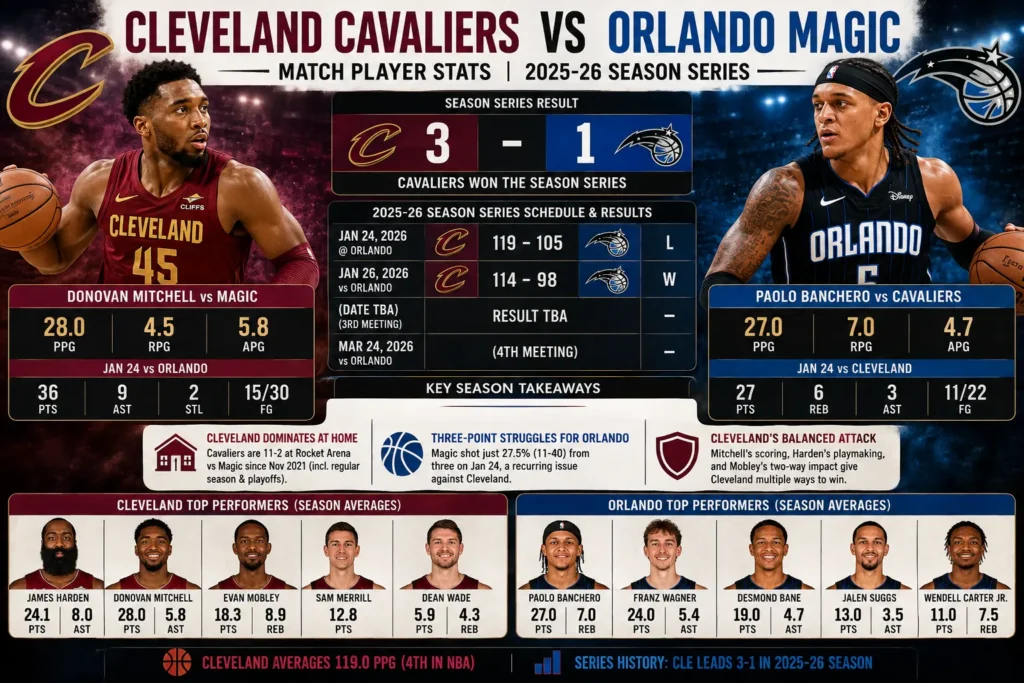
Cleveland and Orlando played four times during the 2025-26 regular season, with Cleveland controlling the series:
- January 24, 2026 (Orlando): Cavaliers 119, Magic 105
- January 26, 2026 (Cleveland): Cavaliers 114, Magic 98
- A third meeting fell between late January and March, with Cleveland entering their fourth and final matchup holding a 2-1 series edge
- March 24, 2026 (Cleveland): The two teams closed out the season series at Rocket Arena, with Cleveland entering the game at 44-27 and Orlando at 38-33
Cleveland’s dominance at home against Orlando has been a consistent trend well beyond just this season — the Cavaliers came into the March meeting having gone 11-2 at Rocket Arena against the Magic dating back to November 2021, including both regular season and playoff games.
Key Player Stats: January 24 Matchup
Donovan Mitchell’s Second-Half Explosion
The clearest standout individual performance of the season series came in the January 24 game in Orlando, where Donovan Mitchell scored 36 points, with 27 of them coming in the second half alone. He shot 15-of-30 from the field, adding 9 assists and 2 steals as Cleveland pulled away down the stretch.
Supporting Cast Stepped Up
Jaylon Tyson added 17 points off Cleveland’s bench in that same game, while Evan Mobley contributed 13 points and 7 rebounds — the kind of secondary scoring punch that gave Cleveland separation once Mitchell got hot in the third quarter.
Paolo Banchero and Orlando’s Response
Paolo Banchero led Orlando with 27 points in the loss, with Desmond Bane adding 20 and Anthony Black chipping in 16 points, 5 rebounds, and 5 assists. Jalen Suggs, playing in his return from a bruised right knee that had cost him eight games, added 9 points and 6 assists in a limited 24 minutes.
The Three-Point Line Told the Story
Orlando shot just 11-of-40 (27.5%) from three-point range in that January 24 loss, dropping their third straight game — a shooting slump that Cleveland’s defense had a hand in creating by closing out hard and forcing Orlando into more difficult, contested looks than they wanted.
Season-Long Context: Cleveland’s Top Performers vs Orlando
Heading into the March 24 finale, Cleveland’s key contributors were putting up the following season averages, giving a sense of who Orlando had to game-plan around across the series:
- James Harden: 24.1 points, 5.0 rebounds, 8.0 assists per game
- Donovan Mitchell: 28.0 points, 4.5 rebounds, 5.8 assists per game
- Evan Mobley: 18.3 points, 8.9 rebounds, 3.6 assists, 1.9 blocks per game
- Sam Merrill: 12.8 points per game, a reliable perimeter scoring option off the bench
- Dean Wade: 5.9 points and 4.3 rebounds, valuable frontcourt depth
That combination of Harden’s playmaking, Mitchell’s scoring, and Mobley’s two-way impact gave Cleveland multiple different ways to attack an Orlando defense that had to account for all three at once.
What the Numbers Say About the Matchup
Cleveland’s Home-Court Advantage Was Real
The 11-2 record at Rocket Arena against Orlando since late 2021 is a meaningful trend, not a small-sample fluke — it reflects a genuine stylistic advantage Cleveland has built against this specific opponent in their own building, likely tied to crowd energy and Cleveland’s ability to control tempo at home.
Cleveland’s Recent Form Heading Into the Finale
Cleveland entered the March 24 matchup having won 4 straight road games, including wins over Milwaukee, Chicago, and New Orleans, and were averaging 119.0 points per game on the season — 4th-best in the NBA and 2nd in the Eastern Conference. That kind of offensive form made them a tough matchup for an Orlando defense that had its own inconsistencies during stretches of the season.
Orlando’s Three-Point Shooting Was a Recurring Vulnerability
The 27.5% mark from three in the January 24 game wasn’t an outlier for Orlando against Cleveland specifically — perimeter shooting struggles against Cleveland’s length and defensive rotations were a theme that showed up across multiple meetings between these two teams, both in the regular season and in their prior playoff history.
Common Mistakes When Reading Season Series Stats Like These
- Judging a series off one blowout or one nail-biter. A four-game regular-season series can include one lopsided result and three close ones — always check the full game log before assuming a series was one-sided throughout.
- Ignoring who was actually available. Jalen Suggs playing through a knee injury, or Paolo Banchero potentially resting or managing minutes at different points in the season, can meaningfully shift what a single game’s stat line actually represents.
- Treating season averages as fixed against every opponent. A player’s overall scoring average can differ significantly from their production against a specific opponent — Mitchell’s 36-point outburst in one game doesn’t mean he averaged that across the whole season series.
- Overlooking bench production. Role players like Jaylon Tyson and Sam Merrill often decide close games between two teams whose stars are largely canceling each other out.
Best Practices for Following a Head-to-Head NBA Series Like This
- Check the full game-by-game series log, not just the final head-to-head record, since margin of victory and shooting trends tell a fuller story than win-loss alone.
- Pay attention to injury reports and availability for each specific game, since a single missing starter can swing an individual matchup significantly.
- Use official sources like NBA.com and Basketball-Reference for verified box scores and season stat lines rather than relying on secondhand recaps.
- Track shooting splits, especially three-point volume and accuracy, since perimeter shooting variance often explains blowout results better than overall talent gaps.
Personal Experience
I started paying closer attention to this specific matchup after the two teams’ 2024 playoff series, which was a genuinely tense seven-game battle that ended with a young, hungry Orlando roster pushing Cleveland to the brink. Going into the 2025-26 regular season series, I expected something similarly close, given how competitive that playoff history had been.
What actually surprised me watching the January 24 game was how quickly Cleveland separated once Mitchell got going in the third quarter. I’d been tracking the box score expecting a tight fourth quarter finish based on the playoff history between these two teams, and instead watched Cleveland’s lead balloon as Orlando’s three-point shooting completely dried up. That was a good reminder that regular-season form and playoff intensity don’t always translate directly — a team playing loose in a January regular-season game can look completely different from the same roster grinding through a seven-game playoff series months earlier.
The other thing that stuck with me digging into the season series afterward: Cleveland’s 11-2 home record against Orlando dating back years isn’t something you’d necessarily guess just from watching one or two recent games. It took looking at the actual historical head-to-head trend to appreciate how consistent that home-court edge has been, well beyond just this particular season. It’s a useful reminder that a team’s record against a specific opponent, especially at home, is often worth checking directly rather than assuming it mirrors their overall season performance.
FAQs
1. How did the Cavaliers do against the Magic in the 2025-26 regular season? Cleveland won at least the first two meetings and held a 2-1 series edge heading into their fourth and final matchup on March 24, 2026, continuing a strong recent trend against Orlando.
2. Who had the best individual performance in the Cavaliers-Magic season series? Donovan Mitchell’s 36-point outburst on January 24, 2026, with 27 points coming in the second half, was the standout individual performance of the season series for either team.
3. How does Cleveland’s home record against Orlando look historically? The Cavaliers were 11-2 at home against the Magic dating back to November 2021 heading into their March 2026 matchup, including both regular season and playoff games — a genuinely strong long-term trend.
4. Did Cleveland and Orlando meet in the playoffs recently? Yes, the two teams played a competitive seven-game first-round series in the 2024 NBA Playoffs, which added extra intensity to their subsequent regular-season meetings.
5. Where can I find official box scores for Cavaliers vs Magic games? Verified box scores and player stats are available through NBA.com’s official stats section and Basketball-Reference, both of which track official league data for every game.
Conclusion
The Cleveland Cavaliers vs Orlando Magic 2025-26 season series continued a pattern that’s been building for years — Cleveland’s depth, home-court advantage, and star power giving them a consistent edge over an Orlando team that remains dangerous but has struggled to solve the Cavaliers specifically, especially from three-point range. Donovan Mitchell’s explosive January performance and Cleveland’s strong overall offensive form heading into the finale were the clearest signals of why the Cavaliers controlled this particular matchup.
Actionable takeaways:
- Check the full season series log rather than relying on a single game’s result to judge how two teams actually match up.
- Watch injury reports and player availability closely, since they can dramatically shift individual matchup outcomes.
- Pay attention to three-point shooting splits specifically when evaluating what decided a lopsided result.
- Use verified official sources for box score and season-average data rather than secondhand recaps.
If you’re building a sports content site or fan community around data-driven breakdowns like this one, aimaghub.com is worth a look for the broader toolset behind that kind of build.
For further reading on this matchup and the surrounding 2025-26 NBA season, see ESPN’s NBA coverage, The Athletic’s in-depth NBA analysis, and Cleaning the Glass’s advanced NBA statistics and shot-quality breakdowns.
Disclaimer: This article is for general informational purposes only and reflects publicly available statistics from the 2025-26 NBA season current as of the time of writing. Player stats and records may change as the season progresses — always check official sources like NBA.com for the most current numbers. This content is not affiliated with or endorsed by the NBA, the Cleveland Cavaliers, or the Orlando Magic.