Introduction
Some first-round playoff matchups feel like a formality. The Cleveland Cavaliers vs Toronto Raptors series in the 2026 NBA playoffs was not one of those. As the East’s 4-seed against the 5-seed, this was always going to be competitive on paper, but nobody watching Game 1 could have predicted it would take a full seven games — and a nail-biting final one — to settle it.
If you’re searching for Cavaliers vs Raptors match player stats because you’re doing fantasy research, catching up on a series you missed, or just want the real numbers behind how Cleveland advanced, this breakdown covers the full series results, the Game 7 box score in detail, and the individual performances that actually swung it.
The Series at a Glance
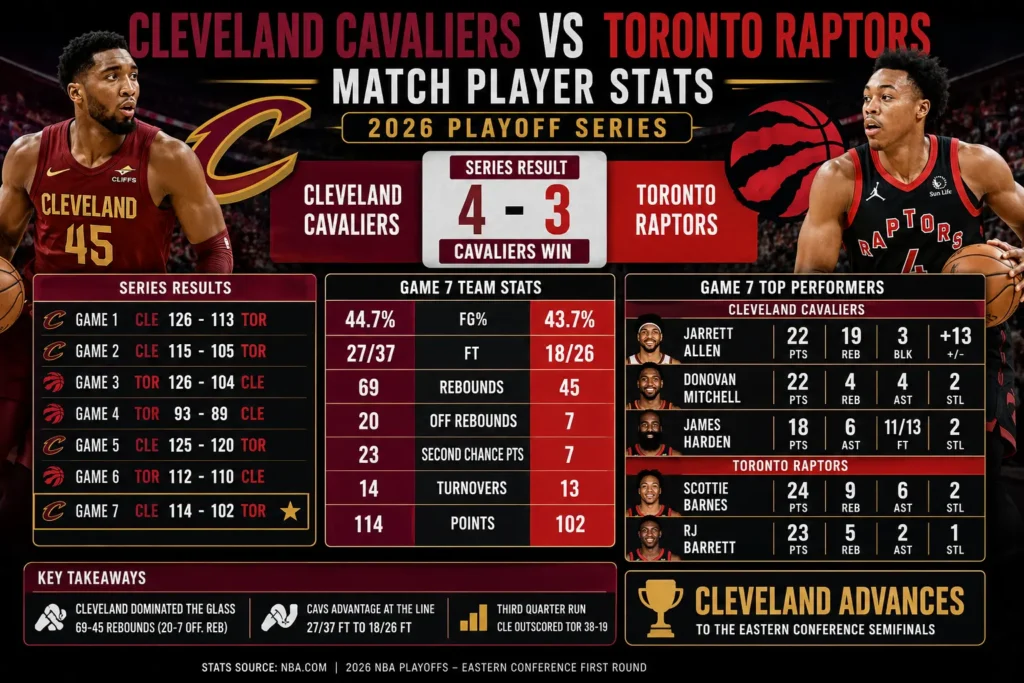
Cleveland and Toronto split the first six games of their Eastern Conference first-round series, setting up a decisive Game 7 in Cleveland:
- Game 1 (Cleveland): Cavaliers 126, Raptors 113
- Game 2 (Cleveland): Cavaliers 115, Raptors 105
- Game 3 (Toronto): Raptors 126, Cavaliers 104
- Game 4 (Toronto): Raptors 93, Cavaliers 89
- Game 5 (Cleveland): Cavaliers 125, Raptors 120
- Game 6 (Toronto): Raptors 112, Cavaliers 110
- Game 7 (Cleveland): Cavaliers 114, Raptors 102
Cleveland won the series 4-3, closing it out at home behind a dominant third quarter that turned a tight game into a comfortable win. The Cavaliers would go on to beat the top-seeded Detroit Pistons in a second seven-game series before eventually falling to the New York Knicks in the Eastern Conference Finals.
Game 7 Box Score Breakdown
Team Totals
Cleveland shot 44.7% from the field compared to Toronto’s 43.7%, but the difference came at the free-throw line and on the boards. The Cavaliers went 27-for-37 from the line against Toronto’s 18-for-26, and out-rebounded the Raptors 69-45, including a lopsided 20-7 edge on the offensive glass. That extra possession advantage showed up directly in second-chance points, where Cleveland outscored Toronto 23-7.
Jarrett Allen’s Double-Double Anchored the Win
Center Jarrett Allen was the clear standout in the closeout game, finishing with 22 points and 19 rebounds — 8 of them offensive — on 7-of-11 shooting, adding 3 steals, 3 blocks, and a team-high plus-13 in the plus-minus column. His rebounding alone accounted for nearly a third of Cleveland’s total boards on the night.
Donovan Mitchell and James Harden Carried the Scoring Load
Donovan Mitchell led all scorers with 22 points on 9-of-20 shooting, while James Harden added 18 points, going 11-for-13 from the free-throw line — a reflection of how effectively he drew contact and got to the line in a game where the Cavaliers shot 10 more free throws than Toronto overall.
Toronto’s Scottie Barnes and RJ Barrett Kept It Competitive
On the Raptors’ side, Scottie Barnes was efficient and productive with 24 points on 57.1% shooting, adding 9 rebounds and 6 assists. RJ Barrett added 23 points but needed 25 shot attempts to get there, shooting just 36% from the field — a volume-over-efficiency performance that reflected Toronto’s broader shooting struggles as a team down the stretch.
The Third Quarter Was the Turning Point
Cleveland outscored Toronto 38-19 in the third quarter of Game 7, the single biggest quarter of the entire series for either team. That burst turned a tight two-point halftime margin into a lead Toronto never seriously threatened again, even after outscoring Cleveland in the fourth quarter.
Series-Long Player Performance Trends
Cleveland’s Depth Was the Difference
Across the seven games, Cleveland consistently got contributions beyond its top two scorers — Evan Mobley, Max Strus, and Jaylon Tyson all factored into different games, giving the Cavaliers multiple avenues to win even when Mitchell or Harden had an off shooting night, which happened more than once given the series’ physical, defensive-minded nature.
Toronto’s Perimeter Shooting Was Inconsistent
Toronto shot 28.6% from three-point range in Game 7, a number that reflects a broader series-long struggle from beyond the arc for the Raptors. When shots weren’t falling, Toronto leaned heavily on players like Barrett attacking off the dribble, which worked in flashes but wasn’t efficient enough over a full seven-game sample against Cleveland’s size advantage inside.
The Rebounding Battle Decided More Than One Game
Cleveland’s offensive rebounding, led by Allen and Strus, was a recurring series theme. Extra possessions off the offensive glass consistently gave Cleveland more scoring chances than the base shot totals alone would suggest, which matters a lot in close, low-possession playoff basketball.
Common Mistakes When Reading Playoff Series Stats Like This
- Focusing only on the closeout game. Game 7 tells you who won the series, but earlier losses — like Cleveland’s blowout Game 3 defeat — often reveal adjustments both teams made that shaped how the later games played out.
- Overvaluing raw point totals without efficiency context. RJ Barrett’s 23 points in Game 7 looks strong on paper, but the 25 shot attempts it took to get there is a very different story than Allen’s 22 points on 11 attempts.
- Ignoring rebounding and free-throw differentials. Final scores get the attention, but possession-level stats like offensive rebounding and free-throw attempts often explain close series results better than shooting percentages alone.
- Treating a seven-game series as a small, noisy sample. Unlike a single regular-season head-to-head, a full seven-game playoff series is a genuinely meaningful sample size for evaluating how two specific rosters matched up.
Best Practices for Following a Playoff Series Like This
- Check the full game-by-game results before drawing conclusions from any single box score, since playoff series often swing on adjustments made between games.
- Look at team rebounding and free-throw numbers alongside shooting percentages for a fuller picture of what actually decided a close game.
- Use official sources like NBA.com or Basketball-Reference for verified box scores rather than relying on secondhand recaps.
- Pay attention to bench production and depth, not just star player totals, especially in physical, seven-game series where fatigue becomes a factor.
Personal Experience
I followed this series mostly because I had Donovan Mitchell on a fantasy roster, and what stood out watching it unfold was how little the series actually resembled a typical 4-seed-vs-5-seed mismatch. Toronto took two of the first four games, including a genuinely lopsided Game 3 win in Toronto, and for a stretch it looked like Cleveland’s seeding advantage might not mean much.
What actually turned things, watching the box scores game by game, was Cleveland leaning harder into its rebounding advantage as the series progressed. Jarrett Allen’s Game 7 line — 22 points and 19 rebounds, with 8 offensive boards specifically — wasn’t an outlier performance so much as the clearest example of a pattern that had been building across the series. I’d initially been tracking the series mostly through Mitchell’s scoring numbers, and it took actually digging into the rebounding and free-throw columns to understand that Cleveland’s edge was coming from possessions, not just shot-making.
The other thing that stuck with me: RJ Barrett’s Game 7 stat line looked productive at a glance — 23 points is a solid number — but the shooting efficiency told a different story. It was a good reminder that point totals alone can be misleading in a vacuum, and that checking shot attempts and true shooting percentage alongside the raw scoring number usually gives a much more honest read on how a player actually performed.
FAQs
1. Who won the Cavaliers vs Raptors 2026 playoff series? The Cleveland Cavaliers won the series 4-3, closing it out with a 114-102 win in Game 7 at home after the two teams split the first six games.
2. Who had the best individual performance in the deciding Game 7? Jarrett Allen posted a double-double with 22 points and 19 rebounds for Cleveland, while Donovan Mitchell led all scorers with 22 points. Scottie Barnes led Toronto with 24 points on efficient shooting.
3. What decided the series between Cleveland and Toronto? Cleveland’s rebounding advantage, particularly on the offensive glass, and its free-throw attempt edge were consistent factors, culminating in a dominant third quarter in Game 7 that turned a close game into a comfortable win.
4. How far did Cleveland advance after beating Toronto? The Cavaliers went on to beat the top-seeded Detroit Pistons in a second seven-game series before losing to the New York Knicks in the Eastern Conference Finals.
5. Where can I find the official box scores for this series? Verified box scores and game logs are available through NBA.com’s official stats section and Basketball-Reference, both of which track official league data for every playoff game.
Conclusion
The Cavaliers vs Raptors 2026 first-round series delivered exactly the kind of competitive, back-and-forth basketball that seven-game playoff matchups are supposed to produce. Cleveland’s rebounding depth and free-throw edge, anchored by a monster Game 7 from Jarrett Allen, proved to be the deciding factor over a series where Toronto’s Scottie Barnes and RJ Barrett kept things competitive until the very end. Beyond just who won, the series is a genuinely useful example of how possession-level stats — rebounds, free throws, shot efficiency — often tell a more complete story than final scores alone.
Actionable takeaways:
- Look at rebounding and free-throw differentials, not just shooting percentages, when evaluating what decided a close playoff game.
- Track a series game by game rather than judging it solely by the closeout game.
- Check shot attempts alongside point totals to separate genuinely efficient performances from high-volume ones.
- Use verified official sources for box score data rather than relying on secondhand recaps.
If you’re building a sports content site or fan community around data-driven breakdowns like this one, Aimaghub is worth a look for the broader toolset behind that kind of build.
For further reading on this series and the surrounding 2026 playoffs, see ESPN’s NBA playoff coverage, The Athletic’s in-depth playoff analysis, and Cleaning the Glass’s advanced NBA statistics and shot-quality breakdowns.
Disclaimer: This article is for general informational purposes only and reflects publicly available statistics from the 2026 NBA playoffs. Player stats and series results are accurate as of the time of writing — always check official sources like NBA.com for the most current data. This content is not affiliated with or endorsed by the NBA, the Cleveland Cavaliers, or the Toronto Raptors.